

Traditional PR is dead, and hiring a passive firm to draft polite press releases won't save your bottom line. If you're vetting a reputation management agency, you need search domination and digital asset control, not corporate excuses. Winning your market means owning exactly what buyers see.
You already know the frustration. One rogue hit or defamatory review costs you high-ticket deals before prospects ever reach your calendar. Worse, AI answer engines like ChatGPT and Perplexity scrape that outdated digital garbage and serve it up as undisputed fact. You're bleeding pipeline value, and wasting cash on retainers that change zero search results stops today.
This playbook cuts through agency fluff to show you how to evaluate partners based on search suppression, AI footprint governance, and verifiable revenue impact. Here is how to eliminate malicious hits, dominate Page 1 search results, and engineer an automated review acquisition engine that compounds inbound profit.
Key Takeaways
- Modern reputation control requires algorithmic execution across organic results and AI answer engines, rendering traditional corporate PR completely obsolete.
- Use our five-point vetting framework to evaluate any prospective reputation management agency on technical SEO depth, AI search mastery, and transparent reporting.
- Spot dangerous black-hat shortcuts and fake review networks before low-tier operators trigger devastating search penalties against your brand.
- Connect search suppression and review acquisition directly to inbound deal flow to measure real bottom-line revenue impact instead of vanity metrics.
- Follow an actionable preparation blueprint to audit your digital footprint, eliminate vulnerabilities, and engineer total Page 1 dominance.
What a Modern Reputation Management Agency Actually Does in 2026
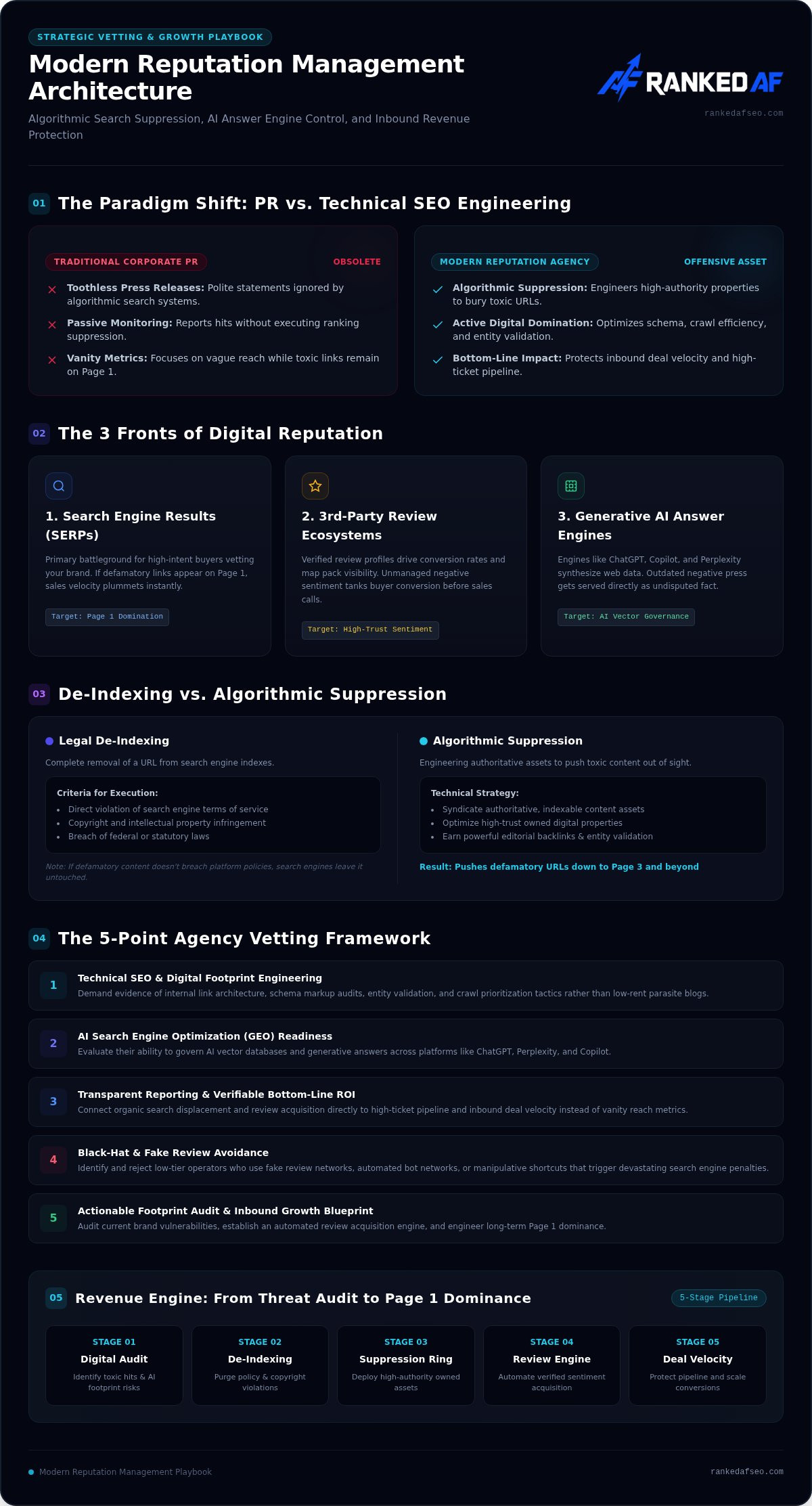
Most corporate PR firms sell you an expensive illusion. They draft toothless press releases, bill you for vague crisis communication retainers, and pray the internet forgets your bad press. It won't. Algorithms do not care about polished statements or polite apologies. Modern reputation management is not public relations; it is aggressive, technical digital engineering designed to control what the market sees and thinks about your business.
A legitimate reputation management agency treats brand narrative as an offensive growth asset. Passive monitoring software only tells you that you are taking hits. Active execution punches back. Real agencies build, optimize, and rank authoritative digital properties that dominate every entry point of your prospect's journey. They turn brand visibility into qualified pipeline and revenue.
The Three Fronts of Digital Reputation: SERPs, Reviews, and AI Engines
Controlling your narrative requires locking down three distinct digital territories:
- Search Engine Results Pages: Traditional organic SERPs remain the primary battleground for high-intent buyers vetting your brand. If toxic links, smear blogs, or hit pieces appear on Page 1, your sales velocity plummets instantly.
- Third-Party Review Ecosystems: Verified review platforms directly drive conversion rates and map pack visibility. Unmanaged, negative sentiment tanks conversion before a lead ever speaks to sales.
- Generative AI Answer Engines: Systems like ChatGPT, Copilot, and Perplexity synthesize web content to produce direct answers about your brand. If negative press dominates your digital footprint, AI regurgitates those controversies to buyers looking for vendor recommendations.
De-indexing vs. Algorithmic Suppression: Tactical Differences
Fixing toxic search results involves two distinct mechanisms: complete de-indexing or relentless suppression. Knowing the difference protects you from false agency promises.
Legal de-indexing removes a URL entirely from search indexes. This tactic works strictly when content violates search engine terms of service, infringes copyright, or breaks federal statutes. If an untruthful blog post does not break clear platform policies, search engines will leave it untouched.
Algorithmic suppression is where real technical skill wins. Instead of begging a webmaster for removal, an elite reputation agency engineers a ring of impenetrable assets. They syndicate authoritative content, optimize high-trust owned properties, and earn powerful editorial backlinks. This strategy pushes defamatory URLs down to Page 3 and beyond, burying toxic links where prospects never click.
The 5-Point Vetting Framework: How to Evaluate Reputation Agencies
Hiring blind will cost you a fortune. Most buyers get charmed by glossy slide decks and vague promises about brand sentiment, only to realize months later that toxic search hits have not budged an inch. If you want results, you must evaluate every prospective reputation management agency against rigorous technical performance standards rather than polished sales pitches.
Top-tier operators deliver comprehensive reputation management services that actively suppress negative entries and seize organic real estate. If an agency cannot audit schema markup, manipulate crawl efficiency, or displace stubborn competitors in organic search, they cannot protect your company. Academic research on evaluating PR and reputation campaigns confirms that true effectiveness requires concrete visibility metrics rather than empty brand reach claims.
Pillar 1: Technical SEO and Digital Footprint Engineering
Demand hard evidence of rank suppression. A competent partner builds indexable, high-authority web properties that push hostile content off Page 1 permanently. Ask them directly about their internal link architecture, entity validation techniques, and crawl prioritization tactics. If they rely on low-rent parasite blogs or free web builders, run away.
Pillar 2: AI Search Engine Optimization (GEO) Readiness
Modern reputation wars are fought inside AI vector databases. When prospective buyers query large language models about your company, what narrative surfaces? Forward-thinking businesses deploy dedicated AI search optimization services to control how generative answer engines ingest their brand data. Ensure your vendor knows how to eliminate hallucinations and secure clean citations across ChatGPT, Perplexity, and Google's AI Overviews.
Pillar 3: Review Acquisition Systems vs. Passive Tracking
Passive monitoring software is useless on its own. You need automated acquisition workflows that trigger customer feedback requests at high-satisfaction touchpoints. Top agencies engineer compliant review collection pipelines that adhere strictly to FTC rules and search platform anti-gating policies. They turn genuine customer sentiment into compounding social proof that powers your core landing pages.
Pillars four and five require rigorous content engineering and unfiltered reporting transparency. Your vendor must syndicate original, authoritative brand assets directly to Google and Facebook while providing transparent tracking dashboards. If you want to audit your current search vulnerability, you can partner with an offensive search team built for narrative dominance.
Critical Red Flags: Shady Tactics That Will Destroy Your Brand
Desperation breeds poor decisions. When a negative headline or coordinated smear campaign strikes, executives panic and throw money at the first firm promising overnight fixes. The online reputation industry is crawling with bad actors peddling dangerous shortcuts. Choosing the wrong reputation management agency doesn't just waste capital; it can trigger manual search penalties and draw federal regulatory crosshairs onto your business.
You cannot afford amateur mistakes when protecting enterprise value. Before signing an engagement agreement, run their strategy against this critical warning checklist.
Purchased Reviews and Review Gating Schemes
Buying fake five-star feedback is commercial suicide. Modern search and directory algorithms instantly flag abnormal review velocity, clustered IP subnets, and unverified user profiles. When caught, your profile faces sudden algorithmic demotion or permanent suspension.
The regulatory fallout is equally severe. Under updated Federal Trade Commission enforcement rules regarding deceptive advertising, brands face penalties up to $10,000 per fake review violation. Legitimate agencies never sell fake reviews. They engineer compliant customer feedback funnels that capture authentic reviews from real buyers at scale.
Toxic Private Blog Networks (PBNs) and Spun Content
Cheap operators still try to displace toxic URLs using spam. They spin low-quality articles and blast them across hidden link networks they control. This tactic creates temporary movement, followed by catastrophic collapse.
Search engine core updates aggressively detect and neutralize automated link farms. Once the algorithm burns that network, your artificial buffer evaporates overnight. Worse, your primary domain risks manual link penalties by association. Sustainable suppression requires high-authority digital PR, original editorial coverage, and authentic asset syndication across tier-one platforms.
Vague Retainers and Unenforceable 'Guaranteed Removal' Claims
Walk away from any reputation management agency promising guaranteed takedowns across public review boards or unmoderated forums. Unless clear statutory violations exist, no agency possesses a secret backdoor to delete public content at will. Firms advertising 100% removal guarantees are usually running refund-churn schemes on desperate clients.
Scrutinize ongoing retainer structures just as hard. Demand unambiguous contract milestones before transferring a dime:
- Explicit Deliverables: Exact schedules detailing newly published properties, syndication distribution channels, and technical on-page implementations.
- Asset Ownership: Unconditional client ownership of every domain, profile, and media property constructed during the engagement.
- Impact Milestones: Measurable SERP position displacement goals instead of passive activity summaries.
Calculating ROI: How Reputation Directly Fuels Inbound Revenue
Treating reputation as an intangible cost center is a massive strategic mistake. Traditional suits look at brand monitoring as an insurance policy they hope never to cash in. Performance-driven leaders know better. In 2026, working with a specialized reputation management agency is an offensive play designed to unlock choked pipelines, shorten sales cycles, and drive top-line expansion.
Every dollar you invest in marketing flows directly into the search bar. High-intent prospects click your ads, browse your landing pages, and immediately Google your business name before signing a contract. If they hit negative press, unaddressed review clusters, or lukewarm customer sentiment, they vanish without a word. Clean, dominant digital real estate converts those leaking prospects into closed deals.
Conversion Rate Economics: The Star-Rating Multiplier
Your public rating directly controls sales friction. Research shows that 93% of consumers state online reviews impact their purchasing decisions, while 70% rarely visit unfamiliar businesses without checking reviews first. Even more telling: a single one-star rating improvement can lift independent business revenue by 5% to 9%.
Lifting a company from a shaky 3.8 to an authoritative 4.7 stars completely transforms your deal velocity. Sales reps spend less time overcoming trust deficits and more time closing terms. Price resistance softens because buyers perceive market leaders as low-risk partners. When you show prospects overwhelming proof of competence, your close rates climb across every channel.
Paid Ad Efficiency and Customer Acquisition Cost (CAC) Reduction
Reputation authority supercharges your paid media performance. When you showcase verified five-star ratings inside your Google Ads assets and Meta campaigns, your click-through rates rise and your Cost Per Click drops. Search algorithms reward high-engagement ads with lower auction costs, directly reducing what you pay to acquire a lead.
Deploying this social proof alongside targeted Facebook ads for local businesses turns paid campaigns into compound growth engines. Clean search pages catch the spillover demand created by paid traffic, preventing high-ticket buyers from defecting to competitors during their final vetting stage.
Stop letting unresolved search results drain your ad spend. To engineer a bulletproof digital profile that turns clicks into verified pipeline, claim your aggressive growth roadmap today.
Hiring Your Growth Partner: Next Steps to Secure Market Dominance
Stop waiting for another defamatory hit or rogue review to derail your pipeline. Leaving your digital narrative unmanaged hands market share directly to your hungriest competitors. If you want absolute authority over what buyers see, you must prepare internally before engaging a performance-driven reputation management agency.
Start by auditing your internal reality. Catalog every owned web property, social profile, and directory listing. Identify the exact search queries where damaging links threaten your deal flow. When your executive team aligns on high-priority search terms and revenue targets, you are ready to unleash an offensive strategy.
The 90-Day Digital Takeover Blueprint
Systematic narrative ownership requires disciplined, phased execution:
- Days 1 to 30 (Audit and Foundation): Conduct forensic audits across organic SERPs and AI answer engines. Reconcile brand entities, correct broken structured data, and launch automated review acquisition pipelines to capture positive customer sentiment immediately.
- Days 31 to 60 (Asset Engineering and Displacement): Build high-authority digital properties and syndicate optimized content directly to Google and Facebook. Channel link equity into trusted assets to force toxic URLs down where buyers never look.
- Days 61 to 90 (AI Graph Locking and Dominance): Reinforce brand facts inside large language model vector indexes. Lock down top-tier search visibility, eliminate hallucinated controversies in AI summaries, and monitor inbound pipeline acceleration.
Why High-Growth Brands Partner With Ranked AF Media Group
We do not deliver corporate pleasantries. We do not bill you for vanity press releases or hide behind vague activity reports. Ranked AF Media Group is the performance-focused anti-agency built for ambitious operators who demand measurable market dominance.
Our methodology combines technical Search Engine Optimization, AI Search Optimization, and conversion-focused systems into a unified digital weapon. We actively neutralize malicious hits, engineer unassailable brand authority, and turn organic visibility into real bottom-line revenue. Ready to take back command of your search results? Partner with Ranked AF Media Group and dominate your market.
Take Total Command of Your Digital Narrative
The digital landscape doesn't forgive hesitation. Leaving your online footprint to chance lets rogue hits and outdated AI summaries dictate your revenue. Choosing the right reputation management agency isn't about buying polite apologies or cosmetic PR fixes; it's about engineering absolute search suppression, securing AI answer engines, and driving measurable deal flow.
Ranked AF Media Group delivers end-to-end integration across advanced SEO, AI Search, and automated syndication directly to Google and Facebook. We maintain zero tolerance for black-hat gimmicks or useless corporate PR fluff. Instead, we bring a national track record of engineering digital dominance and conversion growth to businesses ready to win. Don't let toxic search hits steal your pipeline. Take Control of Your Search Results with Ranked AF Media Group and cement your authority today.
Frequently Asked Questions
How much does a reputable reputation management agency cost per month?
Pricing for a dedicated reputation management agency depends on brand footprint complexity, competitive search volume, and the severity of existing negative assets. Professional firms deploy custom monthly retainers scaled to the engineering required, link acquisition demands, and content syndication workflows. Beware of vendors offering cheap flat-rate packages. Low-cost services rely on ineffective automated software or dangerous spam tactics that fail to solve high-stakes search issues.
Can a reputation management firm permanently delete negative Google reviews?
No legitimate agency can wave a magic wand and instantly delete authentic Google reviews. Direct removal only occurs when a review violates Google's explicit prohibited content policies, such as hate speech, conflicts of interest, or clear spam. For legitimate customer grievances, professional firms implement automated acquisition workflows to flood your profile with authentic five-star reviews. This dilutes bad feedback and lifts your overall rating naturally.
How long does it take an agency to bury a damaging search result?
Sustainable algorithmic displacement typically requires three to six months of aggressive execution. Search engines re-index and re-rank properties on their own timelines. A competent reputation management agency accelerates this process by publishing authoritative digital assets, executing targeted internal linking, and syndicating fresh content to Google and Facebook. Fast-talking vendors who promise 48-hour overnight fixes are setting your brand up for algorithmic failure.
What is the difference between PR agencies and reputation management agencies?
Traditional PR agencies focus on public optics, press releases, and media outreach. They pitch journalists and hope positive stories get picked up. Modern reputation firms operate as technical search engineers. Instead of chasing vague publicity, they systematically optimize owned web properties, control search indexes, and govern AI answer engines. PR begs for brand attention; reputation engineering seizes and secures digital territory where buyers actually search.
How do modern reputation management companies fix brand mentions in AI search engines?
Top firms optimize how Large Language Models ingest and synthesize your corporate entity. They deploy structured schema markup, publish authoritative cross-referenced data, and clean up conflicting information across high-trust directories. By controlling the primary sources that AI engines like Perplexity, Copilot, and ChatGPT crawl, an experienced team replaces outdated controversies with verified, positive facts inside generative search summaries.
Will hiring a reputation agency put my business at risk of Google penalties?
Hiring an ethical, technical partner will not put your business at risk. Danger only strikes when you hire shady vendors who deploy toxic private blog networks, spun AI spam, or purchased fake reviews. Search engines actively penalize manipulative link schemes and artificial sentiment patterns. Vetting your vendor for white-hat digital PR and compliant review acquisition safeguards your organic search rankings.
What should be included in a standard reputation management service agreement?
Demand transparent, deliverable-based agreements that tie directly to measurable SERP movement. A solid contract must specify asset creation schedules, content syndication channels, and technical on-page optimizations. Crucially, ensure the contract grants your business 100% unconditional ownership over all constructed domains, social profiles, and media properties. Never sign vague retainers that refuse to define exact deliverables or performance tracking protocols.


