
Most landing pages in 2026 are just expensive digital paperweights. You're burning cash on high-intent traffic only to watch users bounce in under three seconds. It's frustrating. It's wasteful. It's avoidable. If your design feels like a 2022 relic, you aren't just losing leads; you're funding your competitor's next vacation. Mastering landing page design best practices 2026 is no longer a suggestion. It is a survival requirement for any brand that actually wants to win.
We know you're tired of "pretty" sites that don't move the needle on your bottom line. You want a site that acts like a 24/7 salesman who never sleeps and never misses a close. This guide delivers the no-fluff checklist your design team needs to build a revenue-generating weapon. We will dive into the mandatory 200ms INP thresholds, the legal reality of WCAG 2.2 compliance, and how to architect pages for Generative Engine Optimization. It's time to stop wasting traffic and start dominating your market.
Key Takeaways
- Rip up the old "hero and three icons" layout. Learn how to design for users who demand instant answers from AI search.
- Deploy "Proof-First" architecture to anchor trust immediately by moving your best results and testimonials above the fold.
- Master the landing page design best practices 2026 needed to dominate both human buyers and high-speed AI search crawlers.
- Use our ruthless checklist to cut the fluff so your headlines don't suggest action; they command it.
- Stop building brochures. Start building revenue-generating weapons that turn expensive traffic into cold, hard cash.
The Death of the Traditional Landing Page in 2026
The "hero image + three icons" layout is a corpse. It's lazy. It's predictable. Worst of all, it's costing you money. In 2026, users don't browse; they hunt. If your page looks like a generic SaaS template from 2022, you've already lost the battle. You aren't competing against other websites; you're competing against the back button. Your layout needs to stop being a "pretty" obstacle and start being a direct path to profit.
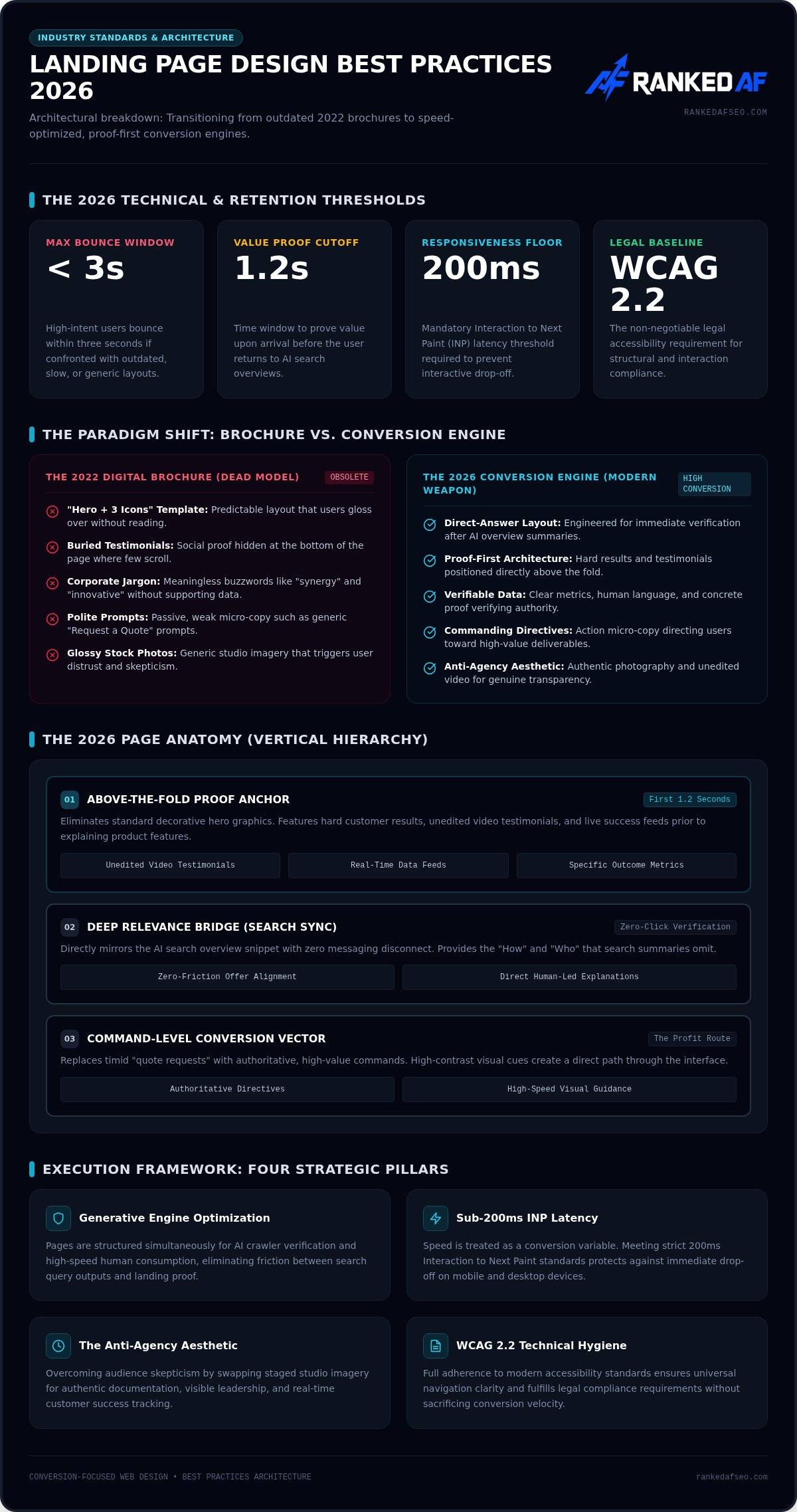
AI Overviews have flipped the script on user behavior. Users get the "what" from search results before they even click your link. They arrive on your page for the "how" and the "who." If you can't prove your value in 1.2 seconds, they're gone. This is why landing page design best practices 2026 focus on immediate utility over decorative aesthetics. You have to earn their time every single second they stay on the page.
Stop building digital brochures. Start building conversion engines. A brochure is a static ego trip that looks pretty but stays broke. A conversion engine is a revenue-generating weapon. It's built for speed, transparency, and raw performance. While traditional landing page mechanics focused on basic lead capture, modern engines focus on closing the gap between search intent and a confirmed transaction.
The Rise of the AI-Native User
Your audience is smarter now. They've spent all day interacting with LLMs that give them direct, fluff-free answers. They arrive on your site expecting hyper-relevance, not a generic sales pitch. They aren't "searching" for info anymore; they are "verifying" your authority. If your site feels like a maze or a wall of text, they'll leave without a second thought.
Fluff is a conversion killer. Corporate jargon is a massive red flag. If you use words like "synergy" or "innovative" without hard data to back it up, you're dead in the water. Speak human. Speak results. Speak with the confidence of a market leader who knows their numbers.
Zero-Click Search and the Landing Page Link
Zero-click search means the user often knows your price or your core offer before they land. They clicked the link because they need one final nudge to pull the trigger. They are looking for the proof that you can actually deliver what the AI summary promised in the search results. They want to see the face behind the brand and the data behind the claim.
This requires "Deep Relevance." Your design must mirror the exact promise made in the search snippet with zero friction. If there's a disconnect in the messaging or a lag in the load time, you're toast. A 2026 Conversion Engine is a speed-optimized, proof-heavy sales tool.
Psychological Triggers: Designing for the 2026 Brain
The 2026 brain is a bullshit detector. It has been trained by years of generic AI content, fake promises, and digital clutter. If your landing page looks like a stock photo gallery, you are invisible. You need to hit them hard. Hit them fast. Hit them with proof. Mastering landing page design best practices 2026 means understanding that trust is earned in milliseconds, not minutes. This is where your strategy shifts from basic aesthetics to psychological warfare.
Proof-First Architecture is the new industry standard. Traditional layouts hide testimonials at the bottom of the page; that is a rookie mistake. Move your strongest social proof above the fold. Let prospects see the wins before they even see your features. Use micro-copy that commands movement instead of politely suggesting it. Don't use a weak "Request a Quote" button. Tell them to "Get Your Revenue Map" or "Claim Your Market Share." Your visual cues must act as a high-speed rail for the eyes, leading directly to the Profit Button.
The "Anti-Agency" aesthetic is winning because it prioritizes reality over polish. People are tired of corporate lies. They want raw transparency. Authentic, unedited photography and gritty video testimonials beat high-production stock images every single time. It feels real. It feels honest. It feels like a partner who actually delivers. Aligning your layout with Google's page experience criteria ensures your technical foundation is solid while your design does the heavy lifting. This is the core of landing page design best practices 2026: cutting the noise to show the value.
Weaponizing Social Proof
Static quotes are dead. In 2026, if a user can't see a video or real-time data, they don't believe the claim. Integrate your reputation management directly into your UI. Show them the live feed of your customer success. This level of transparency builds the technical authority required to dominate the generative era. It's why our AI Search Optimization Services prioritize verifiable data over vague marketing fluff.
The Scarcity and Urgency Myth-Busting
Fake countdown timers are a joke. Your users know they are just scripts designed to manipulate them. Using them kills your brand trust instantly. Instead, use real-world urgency. Show actual lead volume. Show project availability. Show the remaining seats in your calendar. Use no-nonsense language that respects the reader's intelligence. If you want a page that actually converts, you need to be a straight shooter.
We don't just build pages; we build revenue-generating weapons. If you are ready to stop playing small, it is time to upgrade your digital arsenal. Our team specializes in conversion-focused web design that turns skeptics into buyers by focusing on raw performance.
AI-Search Optimization: Designing for Bots and Humans
In 2026, your landing page has two bosses. The human who clicks and the AI bot that crawls. If the bot can't read you, the human never sees you. This is the new reality of landing page design best practices 2026. You need semantic HTML that speaks the language of LLMs. You need an "Entity-First" approach that screams authority. Don't just list features. Define your brand as the definitive answer to a specific problem. This isn't just about keywords anymore. It is about becoming a recognized entity in the global knowledge graph.
Mobile-first is ancient history. Now, we design for "Voice and Vision" search. Users are asking their glasses to find services. They are pointing their cameras at problems and expecting solutions. Your layout must be as clear to a camera lens as it is to a thumb. Building trust starts with this technical clarity. We follow proven design principles for establishing user trust to ensure every element on the page serves a purpose. Be transparent, be fast, and be accurate.
Technical Design for AI Crawlers
Schema is the baseline. You need nested JSON-LD that connects your offer to real-world entities. Don't stop at text. Optimize your visual assets for AI reverse image search. If a user snaps a photo or asks a bot to find a service, your page should be the first result. This technical depth is a cornerstone of landing page design best practices 2026. Use descriptive alt-text that explains the "why," not just the "what." Your design must support AI Search Optimization or it will die in the dark. Bots need to know your location, your reputation, and your specific value proposition in milliseconds.
The Performance-Design Paradox
High-end visuals are great. Slow load times are fatal. You have 0.5 seconds to load the core of your offer. This isn't a suggestion; it's a requirement for 2026. You must balance high-resolution impact with extreme technical performance. Use edge computing to deliver your page from the server closest to the user. Minimize the distance. Maximize the speed. Win the lead. This requires a ruthless approach to code. Strip the bloat. Kill the heavy scripts. Deliver the weapon. In 2026, slow pages are effectively invisible to both users and AI.
The 2026 High-Conversion Landing Page Checklist
Your landing page is a revenue-generating weapon. If it isn't sharp, it's just a waste of server space. In 2026, the margin for error is zero. You don't have time for "maybe" or "eventually." You need results now. This checklist is your battle plan for landing page design best practices 2026. Use it to audit your current assets or build your next campaign. If you miss even one of these, you are leaving money on the table for your competitors to grab.
- The 5-Word Headline: Address a specific pain point in five words or less. If it takes longer, it's too slow.
- Immediate Social Proof: A trust signal must be visible without a single scroll. Prove your worth instantly.
- The No-Brainer Offer: If your offer sounds like a "Me-Too" service, no one cares. Make it impossible to refuse.
- The 3-Field Limit: Every form field is a friction point. If you have more than three, kill the rest.
- Foldable Ready: It is 2026. Your page must work perfectly on foldable devices or you lose the high-end market.
The 'Above the Fold' Battle Plan
The fold is where the war is won. Perform the "Squint Test" immediately. Squint at your screen. If the primary CTA isn't the most obvious element on the page, your design is failing. Remove every navigation menu. They are exit ramps that leak expensive traffic. You want a focused funnel, not a sieve. You have three seconds to deliver a value proposition that sticks. If the user has to think, they bounce. If they bounce, you lose.
Conversion Rate Optimization (CRO) Essentials
Build heatmap-ready layouts that prioritize "Hot Zones." These are the high-engagement areas where users naturally look and click. Don't waste time A/B testing minor details like button shades. Test the "Big Rocks" first. Compare your Offer against your Headline. This is where the massive conversion lifts happen. Your "Profit Button" needs to command attention. Use high contrast, bold colors, and imperative language. Make it clear. Make it loud. Make it convert.
Stop settling for mediocre performance. If you want a page that acts like a relentless salesman, you need a conversion-focused web design that prioritizes your bottom line above all else. Let's build a weapon that scales your business.
Conversion-Focused Web Design: The Ranked AF Weapon
Pretty sites are a luxury. Ranked AF sites are a necessity. If your current design looks like a piece of art but functions like a digital paperweight, you're failing. In 2026, the gap between market leaders and also-rans is defined by technical execution and psychological precision. We don't build brochures; we build revenue-generating weapons. Mastering landing page design best practices 2026 isn't just about checking boxes. It is about total market dominance.
Our approach is built on a foundation of raw performance and absolute transparency. We look at your landing page as the salesman that never sleeps. It needs to be sharp. It needs to be fast. It needs to be relentless. While competitors are still arguing over color palettes, we are optimizing for conversion velocity. This is how you win in 2026. You out-pace, out-perform, and out-convert everyone else in your niche. By aligning your assets with landing page design best practices 2026, you ensure your brand is the definitive choice for every high-intent searcher.
We integrate your landing pages with our specialized AI Search Optimization and high-performance PPC management. This creates a closed-loop system designed for one thing: profit. You get the visibility. You get the click. You get the lead. It is a methodical, aggressive approach to growth that leaves nothing to chance. We turn your traffic into a predictable revenue stream by stripping away the fluff and focusing on the bottom line. Every pixel serves a purpose. Every word carries weight. Every interaction is measured against your ROI.
The Anti-Agency Advantage
Stop paying for "creative concepts" that don't pay the bills. Start paying for conversions. Most agencies want to sell you a vibe; we sell you a victory. You get direct access to battle-hardened strategists who are obsessed with your revenue, not junior account managers who are learning on your dime. No excuses. No fluff. Just raw execution. The Ranked AF guarantee is simple: results or nothing. We operate with a level of transparency that traditional agencies fear because our data speaks for itself.
Next Steps: Dominate Your Market
Your first move is a ruthless audit. You need to know if your page is 2026-ready or if it's a legacy liability. Check your load speeds, your mobile touch targets, and your schema architecture. Once the foundation is solid, you scale. Use automated content distribution to syndicate your wins across Google and Facebook. Don't wait for the market to move. Force the market to follow you.
Ready to win? Get a Conversion-Focused Design Audit and turn your site into a weapon that actually scales your business.
Stop Participating and Start Winning
The era of the "pretty brochure" is over. In 2026, your landing page is either a high-performance revenue engine or a liability. You've seen the battle plan. You know the requirements. You need pages that satisfy the skeptical 2026 brain and the aggressive AI crawlers that feed it. Focus on raw speed. Prioritize verifiable proof. Eliminate every friction point that stands between your traffic and your profit.
Implementing landing page design best practices 2026 is the only way to stay visible in a zero-click world. Don't settle for an agency that delivers "creative concepts" while your ROI suffers. We are conversion-focused web design specialists. We are AI search optimization experts. Our results-driven "anti-agency" philosophy ensures your bottom line always comes first. It is time to stop playing defense. It is time to turn your digital presence into a market-dominating weapon.
Stop losing leads and start winning your market with Ranked AF. Your future revenue depends on the actions you take today. Let's get to work.
Frequently Asked Questions
What is the most important landing page design trend for 2026?
The most important trend is deep relevance powered by generative engine optimization. Users arrive on your page expecting an immediate, data-backed answer to the specific query they just asked their AI assistant. If your page doesn't mirror that intent instantly, you're dead. You need to move beyond static layouts. Focus on landing page design best practices 2026 by creating environments that act as verification tools for AI-driven search results.
How many fields should a high-converting landing page form have?
Cap your form at three fields or fewer to maximize conversion velocity. Every additional input is a friction point that kills your ROI. In 2026, users value their privacy and their time more than ever. If you can't get the lead with a name and email, you're asking too much too soon. You want to lower the barrier to entry. Aggressive lead generation requires a frictionless path from interest to action.
Does page speed really affect my conversion rate in 2026?
Speed isn't just a metric; it's a weapon. A one-second delay can gut your conversion rate by 7% or more. In 2026, the benchmark is a 0.5-second load time for core content. If your page lags, users bounce before the first pixel even hits the screen. Slow pages are effectively invisible to AI crawlers and human buyers alike. You need raw, technical performance to dominate your market and scale your revenue.
Should I use AI to design my landing pages?
Use AI for data analysis and rapid prototyping, but don't let it handle the strategy. Generic AI-generated designs lead to "AI fatigue" and lower trust. You need a battle-hardened strategist to architect the psychological triggers that actually close deals. AI is a tool, not a replacement for a conversion-focused web design expert. It can help you move faster, but it won't help you win if the soul of the offer is missing.
What is the difference between a website and a landing page?
A website is a digital brochure for exploration; a landing page is a precision-guided conversion weapon. Websites have navigation menus that leak traffic and distract users. Landing pages have one goal and one path. They are designed to turn specific PPC or SEO traffic into cold, hard cash. If you're sending ad spend to a generic homepage, you're lighting your marketing budget on fire. Focus on the single objective.
How do I optimize my landing page for AI search engines?
Optimize for AI by using semantic HTML5 and comprehensive JSON-LD schema markup. You need to feed the bots structured data so they can cite your brand as an authority. This is a core part of landing page design best practices 2026. Clear passage architecture helps LLM crawlers understand your value proposition in milliseconds. If the bots can't parse your offer, you won't show up in generative search overviews.
Is video content necessary for a landing page to convert?
Video is mandatory for establishing raw transparency and proof. In a world of synthetic AI content, users need to see real people and real results to trust a brand. Use unedited, high-impact video testimonials or product demonstrations above the fold. It anchors the user's attention and proves you aren't just another faceless agency. If you aren't using video, you're leaving a massive trust gap that your competitors will exploit.
How often should I A/B test my landing page design?
Test your page every time you hit a statistically significant traffic threshold. Don't waste time on button colors. Test the big rocks like your primary offer, your headline, or your lead magnet. High-performance marketing requires constant iteration based on real-user data. If you aren't testing, you're guessing. We use data to drive every design decision because pretty doesn't pay the bills. Execution and testing drive the bottom line.


