

A 50-page automated PDF filled with technical jargon doesn't pay your payroll. If your monthly seo report celebrates record-breaking impressions while your sales team starves for qualified pipeline, you are buying an expensive illusion. Most leadership teams know the frustration firsthand: organic traffic climbs, impressions explode, yet closed revenue barely moves. Traditional agencies love hiding behind vanity charts to dodge hard questions about commercial conversions.
You shouldn't have to decipher an encyclopedia just to figure out whether your marketing spend is actually working. Discover the exact executive reporting framework that ditches hollow vanity metrics and ties your organic rankings straight to closed revenue. You will learn how to cut through the fluff, separate real commercial intent from accidental clicks, and hold internal teams or external partners completely accountable.
Here is your definitive blueprint to measure what actually moves the needle, demand real transparency, and turn search visibility into cash flow.
Key Takeaways
- Learn how to structure an executive seo report that connects search visibility across traditional SERPs and AI search engines directly to pipeline revenue.
- Separate vanity metrics from real growth drivers to immediately spot agency incompetence and eliminate traffic that never converts into sales.
- Deploy the battle-tested 5-slide presentation framework built to communicate financial returns, traffic quality, and strategic roadblocks to leadership teams.
- Turn static organic search data into an aggressive revenue engine that informs your conversion-focused web design and high-performance paid advertising campaigns.
What Is an SEO Report in 2026? Cut the Corporate Fluff
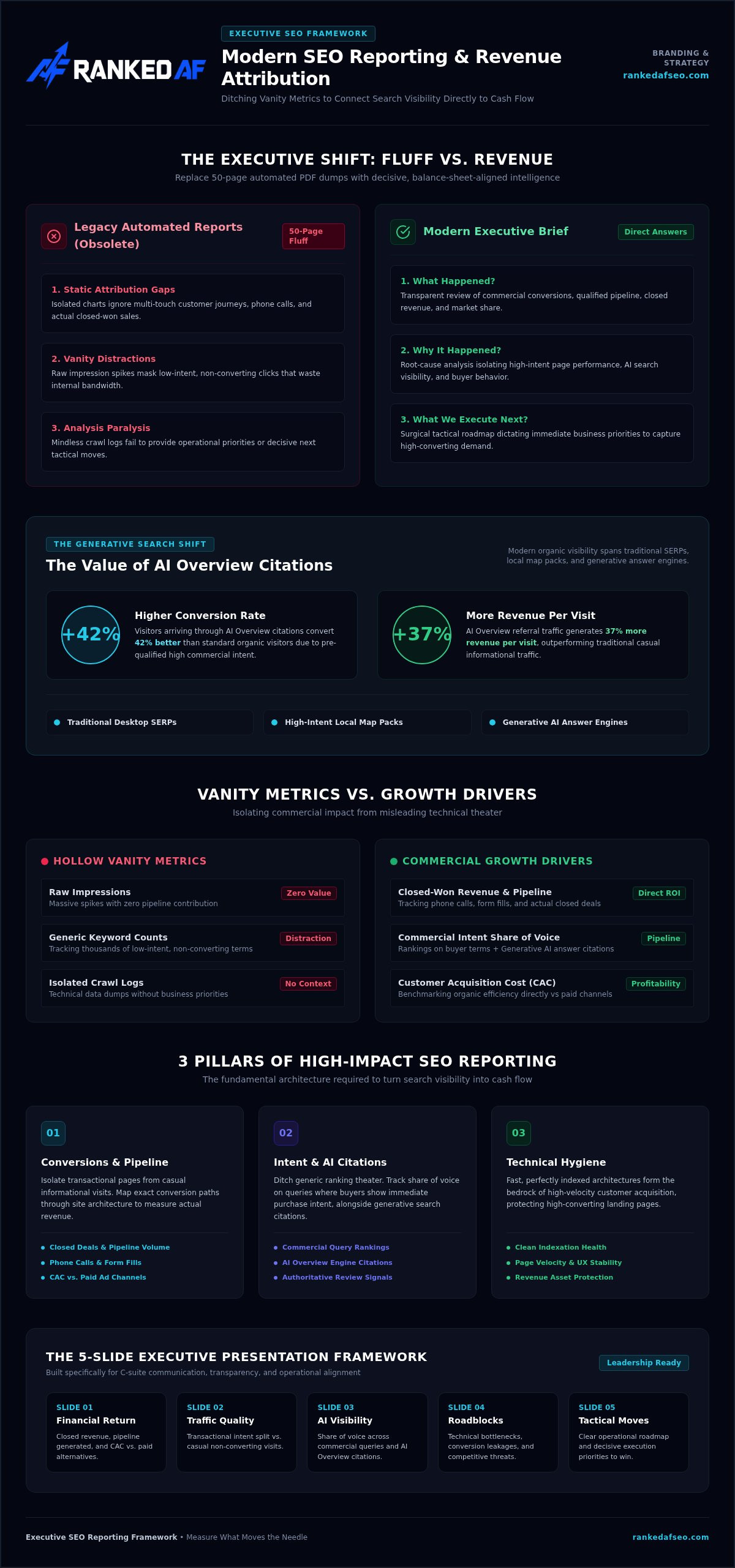
An executive seo report is not a trophy case of arbitrary metrics. It is a rigorous commercial audit that connects search visibility directly to pipeline generation. Modern search no longer stops at ten standard blue links. Today, it spans traditional desktop SERPs, high-intent local map packs, and generative AI answer engines. While foundational Search Engine Optimization (SEO) principles still anchor your digital footprint, treating organic growth as a detached technical exercise is obsolete. Executive briefs replace 40-page metric dumps with surgical clarity. Every slide must answer three direct questions: what happened, why it happened, and what we execute next to win.
The True Business Objective of Modern Search Reporting
Organic search is an aggressive customer acquisition engine, not a soft branding experiment. If your search visibility fails to produce pipeline, lower customer acquisition costs, and crush competitor market share, your investment is bleeding out. Modern marketing metrics must align perfectly with executive balance sheets. Track pipeline volume. Measure closed-won revenue. Scrutinize cost per acquisition. Simply put: an executive SEO report is an actionable revenue roadmap that proves organic visibility converts into cold, hard cash flow.
Why Traditional Automated PDF Reports Are Completely Obsolete
Traditional agency reporting is built to deceive. Weak agencies schedule automated exports on the first of every month, dumping massive PDFs into your inbox to justify their monthly retainer. They deliberately hide flatlined conversion rates behind massive impression spikes and meaningless keyword counts. These static documents leave leadership completely blind:
- Static attribution gaps: Isolated charts ignore multi-touch customer journeys, phone calls, and actual closed-won sales.
- Vanity distractions: Raw impression numbers mask low-intent, non-converting traffic that wastes your internal bandwidth.
- Analysis paralysis: Mindless technical crawl logs fail to provide clear operational priorities or decisive next steps.
Static data without decisive recommendations solves nothing. If your reports fail to dictate your next tactical business move, they are simply corporate clutter.
Core SEO Metrics That Actually Drive Revenue in 2026
Ditch the hundred-row spreadsheets tracking irrelevant keywords. A battle-tested seo report isolates the commercial metrics that put dollars in your operating account. Your dashboard must establish a clear line from search visibility to customer acquisition, especially across national campaigns where competitive pressures run high. When it comes to reporting SEO KPIs to the C-Suite, clarity beats volume every single time. Real executives demand data that proves commercial momentum, not bloated lists of meaningless clicks.
Organic Conversions, Sales Pipeline, and Revenue Attribution
Traffic without conversion is just server strain. Effective reporting isolates your high-intent transactional pages from casual informational blog visits, mapping exact customer conversion paths straight through your site architecture. Track closed deals, phone calls, form fills, and actual qualified pipeline. Calculate customer acquisition cost directly against paid channel alternatives to prove true organic profitability. Layering authoritative review signals via professional reputation management services converts cold search visitors into buyers faster, turning high-ranking pages into high-converting assets.
High-Intent Commercial Keyword Positions and AI Citations
Tracking thousands of generic terms is pure theater. Measure keyword share of voice strictly on commercial queries where buyers show immediate intent to purchase. In 2026, modern visibility also requires tracking presence across generative AI engines, conversational answer interfaces, and AI Overviews. According to industry studies, visitors arriving through AI Overview citations convert 42% better and generate 37% more revenue per visit than standard organic visitors. Partnering with specialized AI search optimization services ensures your brand earns the citations that capture high-converting search volume before your competitors do.
Technical Stability and Indexation Health Baselines
A fast, perfectly indexed site is the foundation of high-velocity customer acquisition. Monitor technical hygiene to protect your revenue-generating pages from costly visibility drops:
- Indexation coverage: Eliminate crawl budget bottlenecks, redirect chains, and broken endpoints that block core product pages.
- Core Web Vitals: Maintain Interaction to Next Paint (INP) scores of 200 milliseconds or less to stop mobile friction from destroying checkout conversions.
- Schema deployment: Deploy clean structured data to claim rich snippets, product carousels, and entity verification across major search engines.
If your current reporting ignores these commercial drivers, it's time to upgrade your strategy with an aggressive partner at Ranked AF Media Group.
Vanity Metrics vs. Growth Drivers: How to Spot Incompetence
Agencies love dressing up dead accounts with vanity theater. When an agency delivers a monthly seo report packed with skyrocketing impression charts, don't celebrate. Ask how many of those impressions converted into signed contracts. Incompetent vendors weaponize raw activity to mask zero business growth. You need to know the difference between numbers that look impressive and numbers that fund payroll.
| Vanity Metric (Agency Excuses) | Growth Driver (Executive Reality) |
|---|---|
| Raw Pageviews and Impressions | Sales Qualified Leads (SQLs) and Closed Revenue |
| Total Backlinks Acquired | Contextual Authority on Monetized Pages |
| Proprietary "Domain Authority" Scores | Share of Voice on Commercial-Intent Keywords |
| Top-of-Funnel Informational Traffic | Customer Acquisition Cost (CAC) Efficiency |
Total Traffic Volume vs. High-Intent Commercial Impressions
Fifty thousand casual visitors reading a beginner definition won't buy your services. Two hundred commercial prospects searching for an immediate solution will. When an agency boasts about viral blog traffic, filter Google Search Console by intent. Broad informational spikes distort analytics dashboards, ruin conversion rates, and waste your sales team's energy chasing tire-kickers. Demand visibility metrics isolated entirely to pages that drive revenue.
Domain Authority and Link Totals vs. Bottom-Line Conversions
Third-party authority scores mean nothing to search engines. Google does not calculate proprietary domain metrics invented by software vendors. Low-tier agencies pump bulk backlink packages containing thousands of spam links that provide zero ranking power. Real authority comes from topical relevance, real traffic, and market credibility. Partnering with a proven reputation management agency secures genuine consumer trust and brand validation that both users and algorithms respect.
When an agency celebrates non-commercial gains, ask them directly: How many closed deals originated from this traffic? What is our customer acquisition cost this month? Which specific pipeline stages did these clicks influence? If they give you blank stares, you are funding their learning curve instead of your own growth.
The 5-Slide Executive SEO Report Template for Leadership Teams
Board members don't have time to wade through endless tabs of crawl errors and keyword shifts. You need a concise seo report deck that delivers complete business clarity in under ten minutes. Replace fifty-page technical dumps with this battle-tested five-slide framework engineered strictly for executive decision-makers.
- Slide 1: Executive Financial Summary. Open with bottom-line impact. Present three core metrics: total closed revenue generated, qualified sales leads captured, and total monthly organic marketing investment.
- Slide 2: Pipeline Velocity and Conversion Efficiency. Display organic conversion rates, average order values, and lead velocity. Calculate your organic ROI directly using a straightforward formula: subtract your total organic investment from attributed gross profit, then divide that net profit by your investment.
- Slide 3: High-Intent Keyword Dominance and AI Visibility. Map ranking movement strictly across commercial-intent terms. Track presence within generative AI engine answers and citation boxes to confirm you are winning conversational search share.
- Slide 4: Traffic Quality and Conversion Architectures. Segment commercial landing pages from top-of-funnel resources. Isolate pages delivering high transaction velocity so leadership knows exactly where to direct technical and design resources.
- Slide 5: Strategic Tactical Roadmap. Detail actionable execution steps for next quarter. Define concrete deliverables, assign operational owners, set firm deadlines, and outline clear plans to capture market share from stagnant national competitors.
Slides 1 & 2: Executive Summary and Commercial Pipeline Impact
Slide 1 cuts straight to the chase. It strips away technical jargon and anchors performance in cash flow. Slide 2 demonstrates how efficiently your web architecture converts that visibility into deals. By linking traffic sources to CRM lifecycle stages, leadership immediately sees how search marketing impacts the company's bottom line without hiding behind soft metrics.
Slides 3 & 4: Commercial Rankings, AI Citations, and Traffic Quality
Slide 3 measures market dominance where it actually matters. It highlights positions for transactional search queries and generative citations that trigger inbound calls. Slide 4 isolates top-performing conversion paths from dead informational pages, confirming your creative resources support revenue-generating assets rather than low-value traffic sinks.
Slide 5: Strategic Action Items and Quarterly Growth Roadmap
Never conclude a meeting without an aggressive plan of attack. Slide 5 functions as an uncompromising operational contract. It details resolved technical roadblocks, content distribution schedules, and outreach targets. Every single line item includes a designated owner and a delivery deadline.
Stop settling for passive status updates that disguise poor performance. Demand complete revenue accountability across your entire digital footprint by teaming up with Ranked AF Media Group to dominate your market.
Turn Static SEO Data into an Aggressive Revenue Engine
Static numbers sitting in a folder are useless. A high-performance seo report functions as an operational launchpad, not an archival record. When you capture deep organic search intelligence, you don't file it away for next month. You feed it directly into your commercial engine. Use winning organic search queries to optimize high-performance Google Ads and paid social campaigns. Deploy search intent data to rebuild sluggish pages. Close the loop between traffic metrics and actual sales execution immediately.
Integrating Real-Time Data Dashboards for Operational Speed
Waiting thirty days to review search performance is business suicide. By the time a traditional monthly PDF arrives, algorithm shifts or broken conversion funnels have already burned thousands of dollars in missed sales. Sync search performance and analytics feeds directly into real-time executive dashboards. Set immediate automated alerts for sudden indexing anomalies, dropped commercial rankings, or broken lead forms. Spotting friction early lets your team patch leaks before they damage your quarterly pipeline.
Channeling Search Intelligence into High-Conversion Landing Pages
Search query data tells you exactly how paying customers describe their problems. Mine your commercial query reports to identify the precise language buyers use right before reaching out. Feed these terms straight into your conversion-focused web design updates, value propositions, and paid marketing campaigns across Google and social channels:
- Refine offer positioning: Update main headlines to mirror high-intent commercial search queries.
- Eliminate design friction: Restructure low-converting pages to guide visitors straight toward phone calls and quote requests.
- Syndicate proven themes: Turn top-ranking search topics into targeted ad creative and multi-channel content syndication.
Enforcing Ruthless Accountability Across Marketing Partners
Stop accepting excuses from underperforming teams. If your marketing vendor celebrates impression spikes while revenue stalls, hold their feet to the fire. Demand reviews that focus exclusively on qualified sales pipeline, customer acquisition cost, and bottom-line revenue growth. When an agency hides behind technical jargon or vanity metrics, cut ties. Work only with aggressive partners who treat your search visibility as an unapologetic profit engine.
Stop Buying Traffic Excuses: Demand Real Commercial Growth
Vanity metrics won't scale your business. If your monthly seo report doesn't draw a straight line from search visibility to qualified pipeline, it is time to change the standard. Stop accepting fifty-page decks full of confusing graphs designed to mask flatlined sales. Focus on commercial search intent, generative AI visibility, and landing pages built to convert cold visitors into signed contracts.
Leadership requires clarity. A streamlined executive reporting framework keeps your teams aligned, exposes marketing incompetence early, and turns raw search data into aggressive operational wins. You deserve a partner obsessed with your revenue, not your impressions. Backed by a proven national track record of engineering conversion-focused web architectures and driving search dominance, we deliver transparent, performance-driven growth tied directly to your bottom line. Take control of your customer acquisition and dominate your market with Ranked AF Media Group.
Frequently Asked Questions
What is the most important metric to look for in an SEO report?
Closed revenue and qualified sales pipeline are the single most important metrics in any executive seo report. Impressions, clicks, and rankings mean nothing if they don't produce customer acquisition. Track pipeline value, cost per acquisition, and closed deals generated from organic search. If your dashboard tracks thousands of visits but can't attribute a single dollar of gross profit, you are reviewing a vanity document rather than a commercial tool.
How often should a business review its SEO report?
Leadership should review high-level commercial outcomes monthly, while operational teams must monitor performance daily through real-time dashboards. Waiting thirty days to discover a broken checkout funnel or dropped indexation burns serious capital. Maintain live tracking for technical health, lead flows, and commercial keyword rankings. Reserve formal monthly reviews for strategic decisions, resource allocation, and holding marketing vendors accountable to quarterly revenue milestones.
Why do most agency SEO reports focus on vanity metrics?
Agencies rely on vanity metrics because raw activity is easy to fake and hides poor conversion performance. Generating millions of impressions on generic, zero-intent blog posts requires minimal effort compared to ranking transactional landing pages that actually close deals. By overwhelming leadership with 50-page PDFs full of crawl scores and superficial keyword jumps, incompetent vendors dodge tough questions about pipeline growth, lead quality, and true return on investment.
What is the difference between an SEO report and an SEO audit?
An SEO audit is a deep diagnostic snapshot of your technical infrastructure, backlink profile, and content architecture. It uncovers underlying problems, code errors, and structural roadblocks at a specific point in time. In contrast, an ongoing seo report tracks dynamic business performance, lead generation velocity, and commercial growth over time. The audit reveals what needs fixing; the report proves whether your strategic execution is generating cash.
How do you measure AI search and generative citations in an SEO report?
Track generative AI visibility by monitoring brand citation frequency, prompt appearance rates, and inclusion in AI Overviews across major search engines. Dedicated search console reports and modern tracking tools show how often your content serves as the cited source for conversational answers. Because visitors referred by AI citations carry significantly higher conversion intent, measuring your entity footprint in LLM responses is essential for modern search dominance.
Can an SEO report prove direct return on investment (ROI)?
Yes, an executive report proves direct ROI when you integrate search analytics directly with your CRM. By tracking first-touch and multi-touch attribution, you can connect organic landing page entries straight to signed contracts and customer lifetime value. Subtract your total organic investment from attributed gross profit, then divide by your marketing spend. Anything less than a clear dollar-for-dollar return calculation is an agency excuse.
What tools are required to build an executive-level SEO dashboard?
You only need three foundational data sources: Google Search Console, Google Analytics 4, and your closed-loop CRM platform. Connect these streams into a centralized business intelligence dashboard like Looker Studio. This setup bypasses static spreadsheets and delivers automated, real-time visibility into conversion funnels, query intent, and revenue attribution. Avoid over-complicated modular tools that inflate reporting costs without adding a shred of actionable commercial insight.


