

Most website redesigns are nothing more than expensive suicide notes for your Google rankings. You hire a "creative" agency, they build a beautiful site that wins design awards, and then you watch your organic traffic plummet by 40% overnight. It's a bloodbath. You need a comprehensive website redesign SEO checklist that treats your site migration like a tactical military operation. If you don't map every move, you lose your territory, your traffic, and your revenue.
We know the fear. You've worked too hard for your rankings to let a new CSS file kill your bottom line. This guide isn't about vanity metrics or "pretty" layouts that fail to convert. We are giving you the exact blueprint to execute a flawless migration that protects your legacy rankings while weaponizing your content for the 2026 AI search landscape. You will learn how to secure your technical foundation, dominate AI Overviews, and turn your new design into a high-octane lead-generation machine. It's time to stop playing defense and start winning. Let's get to work.
Key Takeaways
- Identify and protect your "Money Pages" before the first line of code is written to ensure your revenue doesn't vanish overnight.
- Execute a surgical migration using our website redesign SEO checklist to eliminate the risk of ranking drops and traffic loss.
- Future-proof your digital presence for 2026 by optimizing content for AI Overviews and high-value "Information Gain."
- Transform your site from a vanity art project into a high-octane lead machine designed for raw conversion performance.
- Dominate the post-launch phase with aggressive monitoring tactics that catch and kill indexing errors before they hurt your profit.
Pre-Launch Recon: Auditing Your Current Revenue Drivers
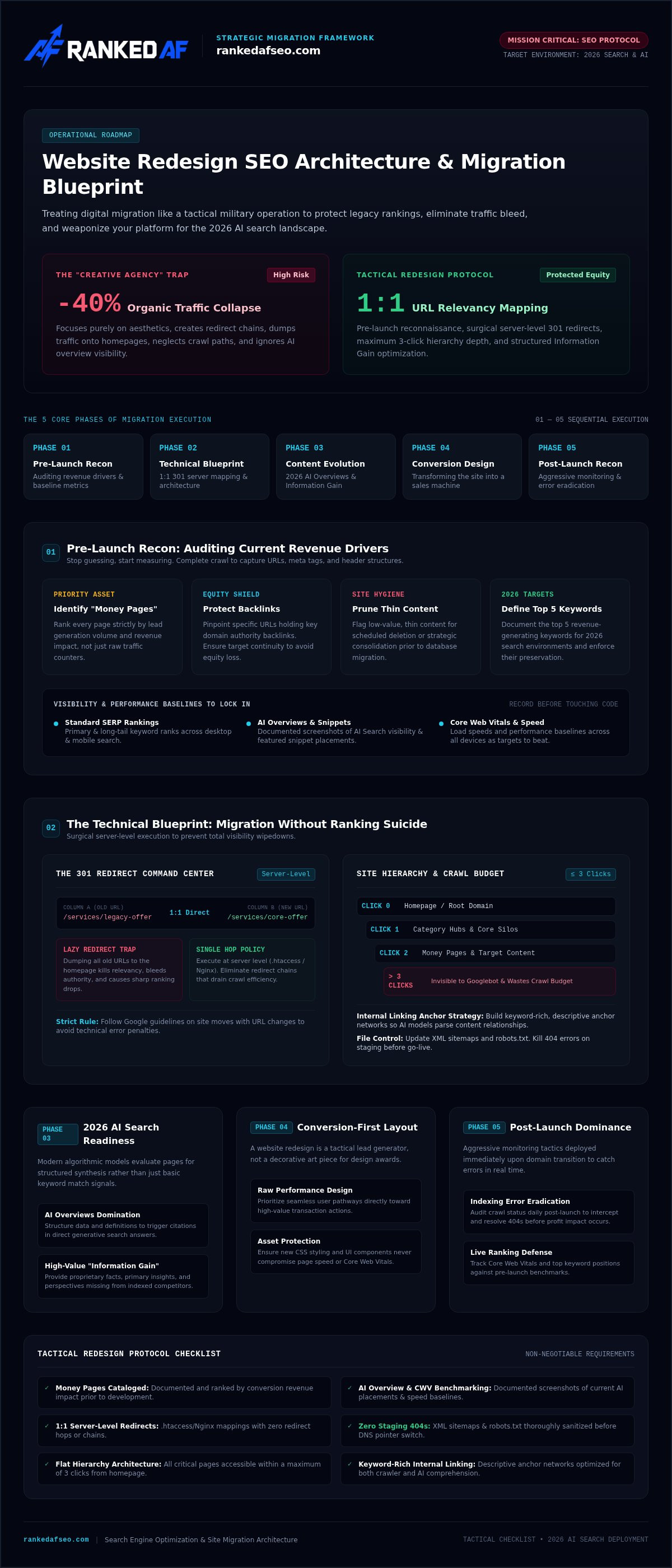
Stop guessing. Start measuring. Most agencies look at traffic charts and call it a day. That's a rookie mistake. Traffic doesn't pay the bills; revenue does. Before you touch a single line of code, you need a complete audit of your digital territory. You cannot protect what you haven't measured. This is the first step in your website redesign SEO checklist. If you miss a high-value page now, it's gone forever. You must crawl your existing site to capture every URL, meta tag, and header structure. This is your baseline for survival.
The Asset Inventory: Know Your Weapons
You need a list of every URL on your current domain. Don't just export a list of status codes. Sort them by conversion value first, then organic traffic. These are your "Money Pages." They are the heavy hitters driving your actual leads. You must also identify high-authority backlinks pointing to these pages. If you lose that equity because you botched your URL redirection methods, your rankings will tank. Use this inventory to decide what stays and what goes.
- Export and Sort: Rank every page by lead volume and revenue impact.
- Protect Backlinks: Identify the pages holding your domain authority together.
- Prune the Rot: Flag "Thin Content" for deletion or consolidation during the move.
- Define Success: Write down your top 5 revenue-generating keywords for 2026 and own them.
Benchmarking Visibility and AI Rankings
Record where you stand right now. You need hard data on your primary and long-tail keyword rankings across standard search. But in 2026, standard SERPs aren't enough. You need to document your AI Search visibility. Take screenshots of where you appear in AI Overviews and featured snippets. This is your baseline. If you don't know where you are appearing in AI-generated results now, you won't know if the redesign killed your visibility later. Speed is also a weapon. Analyze your current page load speeds and Core Web Vitals across all devices. If your new site isn't faster and leaner, you're failing. Capture this data so you have a target to beat. Audit. Benchmark. Win. Don't leave your revenue to chance.
The Technical Blueprint: Migration Without the Ranking Suicide
Map. Redirect. Survive. This is the most critical phase of the operation. If you botch the technical migration, your business dies. Every single old URL must have a 1:1 destination on the new site. Anything less is a gamble you can't afford to take. Don't fall for the "lazy redirect" trap where you dump all old traffic onto the homepage. It kills relevancy. It destroys rankings. It frustrates your customers. You need a surgical approach to preserve every ounce of equity you documented in your pre-launch audit. This is the core of any successful website redesign SEO checklist.
The 301 Redirect Command Center
You need a master spreadsheet that serves as your war room. Old URL in column A. New, relevant URL in column B. No exceptions. Implement these redirects at the server level using .htaccess or Nginx. Speed is a ranking factor; don't let slow middleware drag you down. Test for redirect chains religiously. You want one single jump from the old path to the new one. Every additional hop bleeds link equity and slows down the crawl. Follow Google's guidelines on site moves with URL changes to ensure you aren't flagged for technical errors. Precision here means the difference between a minor dip and a total wipeout.
Site Architecture and Crawl Budget Optimization
Flatten your site hierarchy now. If a page is more than three clicks from the home page, it's essentially invisible. Modern SEO demands a lean, accessible structure. You want Google's crawlers to find your high-value content without burning through your crawl budget on useless directories. Internal linking is your secret weapon. Use descriptive, keyword-rich anchor text to pass authority between pages. This isn't just about navigation; it's about building a web of relevance that AI search models can understand. Update your XML sitemaps and robots.txt to point exactly where you want the bots to go. Kill 404 errors on the staging site before they ever reach your live domain. A clean technical launch is a profitable launch. If you want a partner who treats your migration like a high-stakes mission, look into our search engine optimization services to secure your rankings.
Content Evolution: Optimizing for 2026 AI Search Environments
Content is your ammunition. In 2026, it needs to be AI-ready. If you are following a standard website redesign SEO checklist, you're probably only thinking about meta tags and keyword density. That's a legacy mindset. You need to optimize for "Information Gain." AI models don't want to cite the same generic garbage everyone else is publishing. They want unique insights, proprietary data, and sharp perspectives. Refresh every outdated statistic. Update every year mentioned in your headers. Freshness signals authority to the algorithms that decide who wins the AI Overview box. If your content doesn't offer something new, it doesn't exist.
Weaponizing Content for AI Overviews
You aren't just writing for humans anymore; you're writing for the engines that summarize your work. Use clear, authoritative sections that answer "What is" and "How-to" questions directly. This is how you win AI citations and stay relevant in a zero-click world. Structured Data (Schema) is no longer an optional extra. It is the mandatory map for AI crawlers. Implement FAQ Schema to dominate the "People Also Ask" sections and provide clear paths for generative engines to follow. Your brand voice must be consistent across every page to build E-E-A-T. AI models favor entities they can verify as experts through consistent, cross-platform messaging. Check Forbes Advisor's website redesign guide for strategic frameworks on aligning your brand identity with this level of content authority.
Pruning and Consolidating for Authority
Kill the fluff. If you have five mediocre articles on the same topic, merge them into one "Power Pillar" page. This concentrates your ranking power and eliminates internal competition that confuses crawlers. Once your content is consolidated, update your internal links to point directly to these new, high-performance assets. This isn't just about cleaning up your site; it's about building a fortress of relevance that search engines cannot ignore. For a deeper dive into winning the generative era, explore our AI search optimization services. Every piece of content on your new site must serve a purpose. If it doesn't drive a lead or provide unique value, delete it. A lean, high-impact site will always outrank a bloated archive of yesterday's news. Success in 2026 requires brutal efficiency and a focus on raw performance.
Conversion-First Design: Your Site Is a Salesman, Not an Art Project
Stop paying for art. Start paying for results. Most agencies want to build you a digital museum that looks great in their portfolio but does nothing for your bank account. That's a scam. A site that looks pretty but doesn't convert is just an expensive business card. You need a website redesign SEO checklist that treats design as a sales tool, not a creative outlet. Design for leads. Optimize for profit. Dominate the competition. If your new look doesn't weaponize your traffic, you're just decorating while your revenue dies.
UX/UI That Closes the Deal
Every pixel on your screen must serve a purpose. Put your high-impact CTAs where they can't be ignored. Above the fold. At natural scroll-stops. In every high-traffic sidebar. You want to make it impossible for a prospect to miss the next step in the sales funnel. Simplify your forms until they are frictionless. If you're asking for a home address and a blood type just to send an ebook, you are losing money. Every extra field is a barrier to entry. Surround your buttons with social proof near every conversion point. Reviews, industry logos, and trust badges should be visible the moment a visitor considers clicking. Build trust. Eliminate friction. Close the deal.
Performance Engineering: Speed Is a Ranking Factor
Performance is non-negotiable. Google's Core Web Vitals are the benchmark for survival. Your Largest Contentful Paint (LCP) must be under 2.5 seconds. Anything slower is a signal to Google that your site is a liability. Speed is a ranking factor that directly affects your bottom line. Compress your images into WebP formats to slash load times without losing quality. Minify your CSS and JavaScript to remove the junk that slows down the render. You need a clean, lean HTML structure that crawlers can fly through without hitting a wall. Mobile-first is the only standard that matters in 2026. If your site chokes on a smartphone, you've already lost the battle before it started. Build a site that works fast, looks sharp, and sells hard. If you're ready for a site that actually produces, get a conversion-focused web design that prioritizes your ROI over vanity metrics.
Post-Launch Dominance: Weaponizing Your New Digital Asset
Launch day isn't the finish line. It's the starting gun. Most business owners pop champagne and walk away once the site goes live. That's a fatal mistake. The digital landscape is a battlefield; if you stop moving, you're a target. Most agencies treat launch day like the end of the project. We treat it like the beginning of your market takeover. You've checked every box on your website redesign SEO checklist, but now you have to defend your territory. Monitor Google Search Console like a hawk for indexing errors or sudden traffic drops. Force a re-crawl of your new XML sitemap immediately. Don't wait for Google to stumble onto your new structure. Command the bots to see your work now. Speed, precision, and aggression are your only allies in the first 48 hours.
Immediate Post-Launch Damage Control
The first week is high-stakes recon. You must run a 404 report daily for the first seven days. Even the best migrations miss a few stray URLs; find them and kill them before they frustrate your users or bleed your link equity. Dive into the "Index Coverage" report in Search Console. If Google is excluding pages unexpectedly, you need to know why. Is it a rogue noindex tag? A canonical error? Fix it instantly. Verify that Google Analytics 4 (GA4) is tracking every conversion accurately. If your data is wrong, your decisions will be wrong. Secure your tracking foundation so you can measure your victory in dollars, not just clicks. You need absolute transparency to ensure your new design is actually performing as a high-octane lead machine.
Scaling Reach Through Automated Syndication
Google needs to see immediate activity to validate your new authority. Don't just sit there. Aggressively syndicate your content to build social signals and trigger freshness algorithms. We automate blog distribution to Facebook and Google to ensure your new assets get noticed the second they hit the web. This isn't just about vanity traffic. It's about signaling to AI search models that your site is a living, breathing authority. Leverage facebook ads for local businesses to drive a surge of high-intent visitors to your new "Money Pages." This jumpstarts the machine and forces the engines to take notice. Perform a second comprehensive audit 30 days post-launch. Use that data to refine your AI search strategy and double down on what's working. The migration was the mission. The post-launch is the conquest. Dominate or die.
Own Your Market or Get Left Behind
Your website is either a high-performance weapon or a massive liability. There is no middle ground. You've seen the blueprint. You know the stakes. Executing this website redesign SEO checklist isn't just about avoiding a ranking suicide; it's about positioning your brand as the undisputed authority in a generative search world. Protect your revenue drivers. Execute technical redirects with surgical precision. Optimize for information gain to win AI citations. If you treat your redesign as a mere facelift, you've already lost the battle.
Stop settling for mediocre agencies that prioritize aesthetics over your bottom line. You need a partner who values execution, transparency, and raw financial outcomes. We are the AI Search Optimization experts who build sites that sell. No fluff. No excuses. Just results. It's time to stop playing small and start scaling with Ranked AF. We specialize in no-nonsense, results-driven SEO and conversion-focused web design that turns traffic into profit. The digital landscape is shifting. Move fast, stay aggressive, and claim your victory.
Frequently Asked Questions
Will a website redesign always hurt my SEO rankings?
A redesign only kills rankings if you're lazy. If you follow a rigorous website redesign SEO checklist, you can actually see a traffic surge. Most ranking drops happen because of missed redirects or deleted "Money Pages." We prioritize revenue over vanity. You must map every move, protect every asset, and win every ranking. Don't let a "pretty" design destroy your bottom line. Execution is the only thing that matters.
How long does it take for Google to index a redesigned website?
Google can pick up changes in 48 hours, but a full re-indexing often takes two to four weeks. You don't have time to wait for a crawl. Force the issue. Submit your new XML sitemap to Search Console immediately after the switch. Use automated syndication to trigger freshness signals. We don't wait for Google's permission to win. We take the traffic we want by commanding the bots.
What are the most common SEO mistakes during a site migration?
The biggest killers are "lazy redirects" to the homepage and broken internal links. Many business owners also fail to audit their mobile experience. If it's slow on a phone, Google will bury you. Another massive error is ignoring Core Web Vitals. You need speed, precision, and perfect technical mapping. Don't waste your budget on a site that looks good but won't rank. Focus on performance.
Should I change my URL structure during a redesign?
Don't change your URL structure unless it's a mess. Stability is your friend. If you must change paths for better user experience, every single old URL needs a 1:1 redirect to its new home. Changing URLs without a plan is ranking suicide. It confuses crawlers and bleeds authority. Keep it simple; keep it clean; keep your revenue safe by mapping every single path change before you launch.
How do I optimize my new website for AI search and SGE?
AI search demands structured data and unique insights. You must implement Schema markup so large language models can digest your content easily. Focus on "Information Gain" by providing data that doesn't exist elsewhere. AI models want to cite experts, not echo chambers. Use clear headers and direct answers to win AI Overview citations. This is how you dominate the generative search landscape in 2026. Be the source.
Can I delete old blog posts during a redesign without losing traffic?
You can and should delete thin content that adds zero value. This is called pruning. If a post has no traffic and no backlinks, kill it. If it has equity but the content is trash, consolidate it into a "Power Pillar" page. Just make sure you use a 301 redirect to preserve the authority. Don't be afraid to cut the rot to save the site. Move fast.
What is the role of 301 redirects in a website redesign?
Think of 301 redirects as the bridge between your old success and your new growth. They pass link equity from your old URLs to your new ones. Without them, your backlink profile vanishes. You lose your authority, your rankings, and your leads. A flawless 301 strategy is the backbone of any professional website redesign SEO checklist. It is the most critical technical task you will perform.
How do I test my new website for SEO issues before it goes live?
You test on a staging site before the public ever sees a pixel. Run a full crawl to identify 404 errors and redirect loops. Check your Core Web Vitals to ensure your Largest Contentful Paint is under 2.5 seconds. Verify your Schema markup is valid. We audit, we test, and we win. If it isn't perfect on staging, it isn't ready for your customers. Demand raw performance.


