

What if the keywords draining your budget are the very ones keeping your business from growing? Keyword research services should do more than surface big search volumes. They should answer the question that matters: which terms bring you closer to customers ready to buy?
You already know the frustration. A polished report full of popular keywords can look impressive and still bring in traffic that never converts. Generic tool exports aren’t a strategy. And if your research focuses only on traditional rankings, you could miss opportunities in AI-generated answers and other generative search experiences.
Professional research turns search data into a revenue-focused roadmap. It reveals high-intent terms, competitor gaps, and the topics worth owning. Ranked AF Media Group treats keyword research as the intelligence phase of a broader SEO and AI Search campaign, looking for terms that can drive action, not just clicks. In this guide, you’ll learn how to spot the difference, build a definitive keyword list, and shape a plan for visibility across traditional and AI search. Less guessing. Smarter targeting. A clearer path from search traffic to ROI.
Key Takeaways
- Learn why search volume alone can mislead and how to assess keywords by intent and business fit.
- See how semantic topic clusters can strengthen visibility across traditional search and AI-generated answers.
- Use a practical framework to evaluate a provider’s research process, strategic depth, and approach to generative search.
- Keyword research services should produce more than a spreadsheet: look for insights you can apply across SEO, PPC, and content planning.
- Discover how Ranked AF Media Group approaches keyword research as the intelligence phase of a broader SEO and AI Search strategy.
Why Most Keyword Research Services Are a Waste of Your Budget
A spreadsheet packed with search terms can look like progress. It isn’t a strategy. The basic process of Keyword research can uncover what people search for, but useful research must go further: it has to connect those searches to your offer, your audience, and the action you want visitors to take.
That’s where generic Keyword research services often fall short. They report volume and competition scores, then leave you to figure out what the numbers mean. You’re left with traffic targets, not a clear path to revenue.
The “Tool Export” Scam
Tools like Semrush and Ahrefs can generate keyword ideas quickly. The problem isn’t the software. It’s treating an export as the finished strategy. A list with search volume and an automated difficulty score can’t tell you whether a term fits your business, whether the current results match your expertise, or whether the searcher is ready to act.
Difficulty scores are estimates, not verdicts. A keyword marked “easy” may still be a poor target if the results are dominated by pages that don’t match your capabilities. A competitive term may be worth pursuing if it closely aligns with a valuable offer. Each candidate needs human review: check the search results, assess intent, and decide what useful page could genuinely satisfy the searcher.
Volume vs. Value: The Expensive Mistake
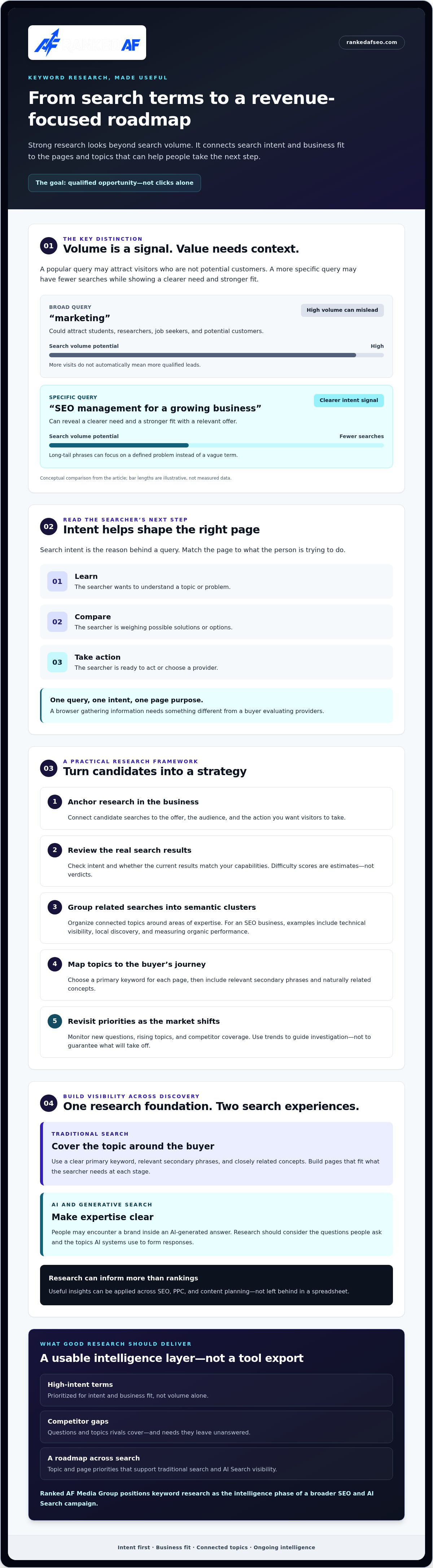
High volume can flatter a report while doing nothing for your bottom line. A broad search like “marketing” could attract students, researchers, job seekers, and potential customers. Ranking for it may increase visits without increasing qualified leads. That’s a vanity metric, not a win.
Now compare it with a specific query like “SEO management for a growing business.” It may attract fewer searches, but the wording can reveal a clearer need and a stronger fit. Long-tail phrases often help businesses compete by targeting a defined problem instead of chasing a crowded, vague term.
Search intent is the reason behind a query, and it’s the signal that tells you whether a searcher wants to learn, compare options, or take action. For conversion, intent matters more than volume alone. A browser gathering general information needs a different page from a buyer evaluating providers. Match the content to the person’s next step.
There’s another costly blind spot: research built only for traditional search rankings. People can also discover brands through AI-generated answers and large language models. If a strategy ignores the questions people ask and the topics AI systems use to form responses, it can miss important visibility opportunities. Keyword research should inform both SEO and AI Search Optimization, not stop at a list of phrases.
The Anatomy of a High-Performance Keyword Strategy in 2026
A keyword strategy isn’t a list you build once and forget. Search behavior shifts, competitors publish, and AI-generated answers change how people discover brands. Strong Keyword research services treat research as an ongoing intelligence phase: they connect search terms to business goals, then update priorities as the market moves.
Start by grouping related searches into semantic clusters. A business offering SEO, for example, might organize topics around technical visibility, local discovery, and measuring organic performance. Each cluster can support a useful central page and related content, giving search engines and readers a clearer picture of the company’s expertise. Competitor gap analysis adds another layer: compare the questions and topics your rivals cover with the needs they leave unanswered. Those gaps may reveal worthwhile opportunities, but they still need to fit your offer and audience.
Traditional Search: Build Coverage Around the Buyer
For traditional search, identify a primary keyword for each page, then add relevant secondary phrases and closely related concepts. Don’t force an “LSI keyword” checklist into the copy. Focus on language that naturally reflects the topic and helps answer the searcher’s question.
Map topics to the buyer’s journey. Someone learning how a problem works needs a different page from someone comparing solutions or ready to choose a provider. Organize your plan around those stages, then monitor emerging questions and rising topics to spot potential opportunities early. Trend data can guide what to investigate, not guarantee what will take off.
AI and Generative Search: Make Your Expertise Clear
Generative Engine Optimization (GEO) adds a new consideration: people may encounter your brand inside an AI-generated answer, not just a traditional results page. AI Search Optimization changes research by putting more weight on natural-language questions, clear explanations, and evidence of relevant expertise. There’s no keyword formula that guarantees an AI platform will cite or recommend a brand.
Make your content easier to understand and verify. Answer specific questions directly, explain terms consistently, and organize information under descriptive headings. Keep business details accurate across your site and other relevant sources. These practices can help search systems interpret what you do, while giving potential customers useful answers.
Review the strategy regularly. Track which topics attract qualified engagement, identify new competitor gaps, and refine both search and AI-focused content. Ranked AF Media Group connects keyword intelligence with SEO and AI Search Optimization. Explore its SEO and AI Search approach to see how research can support a broader visibility strategy.
Professional Keyword Research vs. $50 Tool Exports: The ROI Gap
A quick export gives you phrases and estimates. It doesn’t tell you which terms deserve a page, which could waste ad budget, or how a search connects to a real customer need. The gap isn’t the size of the spreadsheet. It’s the thinking behind the decisions.
The True Cost of DIY and Low-End Services
AI tools like ChatGPT can help brainstorm keyword ideas, but a generic prompt won’t reliably reveal your industry’s competitive landscape, search results, or the intent behind each query. Treat its suggestions as a starting point, not a validated plan. You still need to check whether people search those terms, what content already ranks, and whether the traffic could plausibly become a lead or sale.
That same scrutiny matters in Google Ads. A keyword that sounds relevant can attract the wrong audience. For example, a company seeking leads might target a broad research query, then pay for clicks from people looking for definitions or free resources. If targeting, messaging, and landing pages don’t align, ad spend can accumulate without producing qualified inquiries.
DIY research also consumes time. You have to sort suggestions, compare search results, interpret data, and decide what to prioritize. Without a clear method, it’s easy to publish content for terms that look promising but don’t support a business goal.
The Premium Advantage: Intelligence Over Data
Expert analysis turns raw information into a plan: which topics to target, what kind of page fits each search, and where paid or organic visibility makes sense. It accounts for industry language and customer needs that a generic list can miss. Forecasting should guide decisions, not pretend to predict outcomes: compare emerging queries, competitor coverage, and business relevance, then test and refine.
Some valuable searches show little or no volume in a tool. That doesn’t prove they’ll produce huge revenue, but it also doesn’t make them worthless. A specific phrase describing a pressing need may be commercially relevant even when volume estimates are limited. Evaluate it against customer conversations, your offer, and the search results before investing in a page or campaign.
Brand searches deserve attention, too. Reviews and reputation can shape how people evaluate a business after discovering it. Pairing keyword insights with Reputation Management Services can help you understand how branded searches and customer feedback fit into that decision process.
Professional research is an investment in market intelligence, not just a service. Ranked AF Media Group treats keyword research as the intelligence phase of SEO and AI Search Optimization, with a focus on terms that can support real business outcomes. Explore its SEO and AI Search services to see how research can inform a broader visibility strategy.
How to Vet a Service Provider: The No-Bullshit Evaluation Framework
A confident pitch is easy. A clear, defensible process is harder. Before you hire Keyword research services, find out how the provider moves from raw search data to decisions you can use. They should explain how they assess your site, interpret search intent, and connect recommendations to business outcomes. A proprietary framework can be useful, but transparency and sound reasoning matter more than a branded process.
Five Questions Every Agency Hates
Ask direct questions. Listen for specific answers, not jargon or promises.
- How do you decide whether a keyword is attainable for my site? Look for an explanation that considers your existing content, the pages ranking now, your site’s relevance, and the work needed to compete. A difficulty score alone isn’t a strategy.
- How do you identify search intent? They should explain how they review search results and distinguish research queries from comparison or purchase-ready searches.
- How does your research account for AI search and large language models? Expect a thoughtful approach to question-based searches, clear content, and accurate business information. Be wary of anyone promising guaranteed AI citations.
- How will you measure value beyond traffic? A useful answer connects keyword priorities to qualified leads, sales opportunities, or another agreed business outcome, rather than treating rankings as the finish line.
- How could the research inform my paid strategy? Ask how search insights might help shape campaign targeting and messaging. For example, paid advertising strategy may use audience and customer-language insights differently from search campaigns, but both should support clear business goals.
Red Flags to Watch For
Walk away from guarantees of specific rankings in 30 days. Search results depend on factors a provider can’t fully control, so a credible partner should explain the work, the risks, and how progress will be assessed.
Be cautious if they won’t explain their data sources or how they manually review suggested terms. You don’t need a lecture on every tool, but you should understand how recommendations are checked. A list sorted by volume, with no discussion of intent or conversion potential, is another warning sign. Ask for examples of how a keyword’s relevance to your business changes its priority.
Industry knowledge matters, too. A provider should learn your offer, customer language, and competitive realities before recommending targets. Ranked AF Media Group positions keyword research as the intelligence phase of SEO and AI Search Optimization, with an emphasis on terms that can convert. Explore Ranked AF’s SEO and AI Search services to see whether its approach fits your goals.
Weaponize Your Data: Why Ranked AF Redefines Keyword Strategy
A keyword list tells you what people search. A blueprint shows how to turn those searches into visibility, useful content, and business opportunities. Ranked AF Media Group treats keyword research as the intelligence phase of a broader SEO and AI Search campaign, prioritizing terms that fit your offer and have a credible path to conversion.
That means connecting research to execution. A keyword should inform a clear next step: improve a relevant page, create content that answers a real question, or consider whether a search term fits a paid campaign. If there’s no sensible connection between the query and your business goals, the keyword doesn’t deserve priority just because it looks impressive in a report.
Search doesn’t stop at traditional results pages. Ranked AF specializes in AI Search Optimization, helping businesses consider how their expertise and content can be understood across evolving search experiences. No strategy can guarantee that an AI platform will cite or recommend a brand. But a focused approach can make your information clearer, more useful, and easier for people and search systems to interpret.
The Ranked AF Difference: Results Over Pleasantries
Keyword research services should help you make decisions, not bury you in data. Ranked AF’s conversion-focused approach keeps the business objective in view: attract the right audience, answer the right questions, and give qualified visitors a reason to take the next step. That’s a sharper standard than celebrating rankings without asking whether they support meaningful outcomes.
Distribution matters, too. Useful content needs to reach its audience. Ranked AF’s automated content distribution strategy supports content distribution across channels, while SEO and AI Search Optimization build visibility where people seek answers. The pieces work together: research informs content, distribution extends its reach, and performance gives you evidence to refine future priorities.
Ready to Stop Playing Small?
Start by identifying the searches that align with your offer, the questions your current content leaves unanswered, and the visibility opportunities worth pursuing. Then use that intelligence to guide a focused plan across traditional and AI-driven search. Waiting doesn’t guarantee that a rival will take your audience, but leaving valuable questions unanswered gives others room to compete for attention.
Choose a strategy built around your market, not a recycled list. If you’re ready to strengthen your search visibility, explore how Ranked AF’s SEO and AI Search Optimization can support your next move. Claim a more deliberate position in search: sharper priorities, better content, and a clearer route from discovery to action.
Turn Search Intelligence Into Your Next Advantage
The right keyword strategy does more than earn visibility. It helps you focus on searches that fit your business, build a roadmap for traditional and AI-driven discovery, and connect content decisions to meaningful outcomes. That’s the difference between collecting terms and using search data to make smarter moves.
Keyword research services should bring clarity, not another report full of untapped potential. Ranked AF Media Group pairs no-nonsense, results-driven SEO with expertise in AI Search Optimization. The focus stays on transparency, performance, and terms that can support real business goals, not rankings for their own sake.
Ready to stop guessing and put your search strategy to work? Get a high-performance keyword strategy from Ranked AF. Build with better intelligence, compete with purpose, and take the next step toward stronger visibility.
Frequently Asked Questions
What are keyword research services and why do I need them?
Keyword research services identify the searches your potential customers use and help prioritize the ones that fit your business goals. A strong strategy assesses intent, competition, and the pages needed to answer each query, rather than handing over a list sorted by search volume. This can help you focus SEO, content, and paid advertising on relevant opportunities, avoid mismatched traffic, and build a clearer path from search visibility to qualified leads.
How much do professional keyword research services typically cost?
There isn’t one standard price because scope and strategic depth vary. A basic keyword list is different from research that includes search intent, competitor gaps, topic grouping, AI search considerations, and recommendations for applying the findings. Ask providers what’s included, how they validate keywords, and whether the work connects to your business goals. Compare deliverables and expertise, not just the size of the spreadsheet or the lowest quote.
Can I just use ChatGPT or free tools for my keyword research?
Yes, they can help you brainstorm and organize an initial list, but they shouldn’t be your only source of validation. AI-generated suggestions may be generic or inaccurate, while free tools may provide limited data. Check whether real search results match your topic, what intent those results serve, and whether the term relates to your offer. Use tools to generate ideas, then apply business context and manual review before investing in content or ads.
How long does it take to see results from a new keyword strategy?
There’s no fixed timeline. Results depend on factors such as your website’s current visibility, competition, content quality, and how consistently recommendations are implemented. Keyword research itself provides direction, not instant rankings or leads. Set baseline measures before acting, then monitor relevant indicators such as impressions, qualified visits, inquiries, and conversions. Review progress with your provider and adjust the plan based on actual performance rather than expecting every target to move at the same pace.
What is the difference between SEO keywords and AI search keywords?
They aren’t necessarily separate categories. Traditional SEO research often evaluates the phrases people use in search engines and the pages that rank for them. AI Search Optimization also considers conversational questions, related concepts, and the information systems may use to form answers. The same topic can matter in both settings. Build clear, useful content around real customer needs, and assess visibility across traditional results and AI-generated experiences.
How often should I update my keyword research?
Review it regularly, and revisit priorities when your business, audience, or search results change. A new service, a shift in customer language, fresh competitor content, or changes in campaign performance can all signal that your plan needs attention. Don’t refresh a spreadsheet just to make it look current. Check whether target terms still match search intent, whether pages perform as expected, and whether new questions deserve useful coverage.
Do keyword research services include competitor analysis?
Some providers include competitor analysis, but the scope varies, so confirm it before hiring. Useful analysis goes beyond naming competitors: it examines the topics they rank for, the questions their pages answer, and potential gaps that align with your business. Ask how the provider separates a genuine opportunity from a keyword that’s irrelevant or unrealistic for your site. Competitor data should inform your priorities, not lead you to copy another company’s strategy.
Why is search intent more important than search volume in 2026?
Search intent reveals what a person wants to accomplish, while volume estimates how often a term is searched. A popular, broad query may attract people who aren’t looking for your solution. A more specific query may signal a clearer need, even if fewer people search it. Prioritize relevance and the visitor’s next step, then use volume as one input among several. Traffic matters most when it brings the right audience.


