

A polished law firm website can still lose the right client. Strong law firm website design does more than look credible. It helps visitors understand whom you help, why they should trust your firm, and what to do next. A striking homepage means little if practice areas are hard to find, attorney credentials are buried, or contacting the firm feels like work.
Design inspiration is easy to find. The harder part is distinguishing attractive pages from choices that support usability and qualified inquiries, especially when every agency claims it can deliver results. You need a way to assess the work, not another gallery of polished screenshots.
This guide explains what effective law firm websites do well and how different design approaches can serve different firms. Use a practical framework to compare trust signals, navigation, mobile experience, and contact paths. Then ask sharper questions about a potential web design partner’s process, performance measurement, and site ownership. The goal is to choose a site that reflects your firm, makes the next step clear, and supports the search and lead-generation work around it.
Key Takeaways
- Judge law firm website design by how clearly it builds trust and guides visitors, not by visual polish alone.
- Trace the visitor journey from practice-area information to attorney details and a clear way to get in touch.
- Compare website examples using consistent criteria, then look for evidence behind agency claims, not just attractive portfolios.
- Ask direct questions about content ownership, hosting, analytics access, maintenance, and post-launch support before choosing a designer.
- Plan for measurement and ongoing improvements so the site can support visibility and inquiries beyond launch.
Law firm website design examples: what earns trust at first glance?
An attractive website can still leave a prospective client wondering, “Is this the right firm, and what do I do now?” Strong law firm website design answers both questions quickly. Compare examples by clarity, credibility, accessibility, and how easily visitors can make contact. If a dramatic homepage hides practice areas or makes contact details hard to find, the design is not serving the visitor.
A high-performing law firm website builds trust through clear information, usable design, and a straightforward path to contact. Its visual style should fit the firm’s audience, services, and communication style. A firm serving people in stressful situations may benefit from calm, plain-spoken design. A business-focused practice may call for a more formal presentation. Good web design principles connect layout and user experience to what visitors need, rather than treating appearance as the whole job.
What makes a law firm website feel credible?
Look for attorney biographies that explain relevant experience in plain language, firm credentials that are easy to verify, and practice-area pages that state whom the firm serves. Consistent names, colors, typography, and tone help the site feel like one real firm rather than a collection of disconnected templates.
Client feedback can add useful context when it describes a person’s experience without implying that every matter will end the same way. Be wary of unsupported claims such as “the best firm” or “guaranteed results.” Vague promises say little. Generic stock photos of gavels or anonymous courtrooms can also weaken authenticity if they stand in for specific information about the attorneys and their work.
How should visitors find the next step?
Check whether visitors can find contact options without hunting. Phone and contact details should be easy to locate, navigation labels should describe what’s behind them, and pages should remain readable and usable on a phone. For accessibility, check practical details such as legible text, clear contrast, descriptive form labels, and navigation that works without a mouse.
A direct call to action, such as “Request a consultation” or “Contact the firm,” tells visitors what happens next and reduces uncertainty. The right wording depends on how the firm handles inquiries, so make sure it matches the actual process. Helpful contact options support a visitor’s decision. Aggressive pop-ups, repeated prompts, and cluttered banners interrupt it. Judge each example by whether it makes the next step easier, not louder.
The design elements that turn legal expertise into clear action
Design should make useful legal information easier to understand and act on. It cannot replace clear explanations of the firm’s services, experience, or process. Think of the visitor journey as a sequence: arrive on a relevant page, recognize the legal issue the firm handles, review practice-area details, learn who may handle the matter, then find an appropriate way to get in touch. Each page should make that next step easy to see.
That’s the job of law firm website design: connect expertise with a practical route forward. A page about business disputes, for example, should identify the service in plain language, explain whom it’s for, and direct interested visitors to relevant attorney information or contact options. Descriptive navigation helps people move between those pages without guessing. Readable typography and responsive layouts keep the experience clear on large and small screens.
Which homepage and practice-area features matter most?
Use the homepage to orient visitors, not overwhelm them. Concise service summaries help people identify the practice area they need, while links lead to fuller explanations. Attorney profiles should show relevant experience and a professional human presence, rather than relying on titles alone. Keep calls to action specific and consistent, such as “Contact our employment law team,” and place them where visitors have enough context to respond. The wording and placement work best when they match what a visitor is ready to do.
Keep claims factual and avoid language that promises an outcome. The landmark Supreme Court case on lawyer advertising offers historical context for lawyer advertising, but firms should have their marketing language reviewed against applicable professional requirements.
How do accessibility and mobile usability affect the experience?
Accessibility is part of usability. Check that text has readable contrast, links describe their destination, meaningful images have text alternatives, and visitors can use interactive elements with a keyboard. The Web Content Accessibility Guidelines (WCAG) provide a useful reference, but a design review alone cannot establish legal compliance. Ask a qualified professional to assess the site against the standards and requirements relevant to the firm.
Then test the essentials on a phone: practice-area pages, attorney details, menus, forms, and contact options. Make sure text doesn’t require pinching to read, buttons are easy to use, and important information isn’t hidden behind obstructive elements. If you’re assessing a redesign, consider whether conversion-focused web design can support clear visitor paths alongside broader visibility goals.
How to compare law firm website design examples fairly
A portfolio is a sales tool. Look past polished screenshots and ask what the work proves. Compare each example against the same criteria, then separate visual preference from evidence about usability, fit, and outcomes.
| Criterion | What to look for | Question to ask |
|---|---|---|
| Audience fit | Does the design suit the firm’s clients, services, and communication style? | Who was this site designed to serve? |
| Clarity | Can visitors understand the firm’s focus and find relevant information? | What content or navigation decisions made that easier? |
| Trust signals | Are credentials, attorney information, and client feedback presented clearly and responsibly? | How were claims and testimonials handled? |
| Usability | Are key pages and contact paths straightforward on desktop and mobile? | How was the experience tested? |
| Accessibility | Were accessible interaction and content practices considered? | What review or testing informed the work? |
| Marketing integration | Can the site support search visibility, campaigns, and measurable inquiry paths? | Which marketing goals shaped the build? |
Use the same questions for every agency. A visually striking concept may not suit a firm’s audience. A restrained design may be a better fit if it makes key information easier to find. For a wider look at approaches and trade-offs, see this web design options and comparison guide.
What should a law firm portfolio prove?
Strong portfolio examples explain the client’s goals, the design decisions made to address them, and the project scope. Ask for work that resembles your audience or business needs, not just your practice area. A firm’s size, location, intake process, and resources can all affect what makes a design effective. Awards and polished screenshots offer context, not proof of business performance.
How can firms assess conversion claims?
Ask what counted as a conversion: a completed contact form, a phone call, or another tracked action. Then clarify how the agency defined a qualified lead. Request the starting baseline, measurement period, and context behind any reported change. Were traffic sources, budget, location, and other marketing activity comparable? If the agency can’t explain how outcomes were measured, treat the headline claim cautiously.
Ask for relevant case studies and client references, and confirm what the agency actually handled. Results from another firm don’t guarantee yours will match. Be skeptical of guaranteed rankings, inquiries, or revenue without transparent evidence. Good law firm website design work should come with clear reasoning, realistic goals, and a way to evaluate progress.
Questions to ask before choosing a law firm website designer
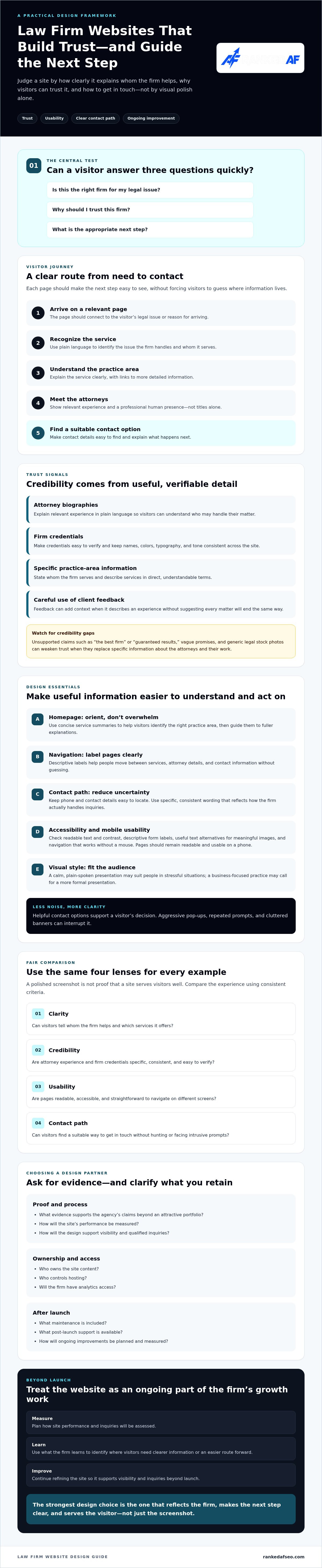
A strong portfolio is only the start. Before signing, find out who will make decisions, who controls the finished site, and what happens after launch. Use four steps to keep the conversation focused: define goals, review evidence, examine the process, and confirm responsibilities.
- Define your goals. Name the audiences, practice areas, and actions the site should support. Ask how the proposed structure will make those goals clear and how the project will account for accessibility, content, and marketing needs.
- Review the evidence. Request relevant examples and ask what the agency did on each project. Look for clear scope and measurable goals, not just attractive screenshots or broad performance claims.
- Examine the process. Ask who writes and reviews content, how feedback and approvals work, and what milestones shape the project. Clarify how the team will test the site before launch.
- Confirm responsibilities. Get written answers about ownership, hosting, analytics access, maintenance, and post-launch support. Make sure you know who handles technical updates, content changes, and any marketing work.
How do you evaluate process, ownership, and support?
Ask who controls the domain, website files, published content, analytics accounts, and hosting account. Clarify whether your firm can access and transfer these assets if it changes providers. Then confirm approval rounds, project milestones, maintenance scope, and expected support response times. Ask who handles backups, security updates, future edits, and migrations, and whether those responsibilities are included or handled separately. Clear answers now can prevent confusion later.
How should legal content and marketing claims be reviewed?
Identify who drafts, fact-checks, and approves attorney biographies and practice-area content. Ask how contact forms collect and route information, who can access submissions, and what privacy notices the site needs. Don’t assume the designer can make these decisions for your firm. Applicable professional conduct and advertising rules can vary by jurisdiction, so have qualified counsel review relevant content and state bar guidance before publication.
Make the scope concrete. If a partner proposes law firm website design alongside search visibility or lead-generation work, ask which tasks are included and who owns each deliverable. A clear division of labor is more useful than vague promises. If you’re comparing providers, review conversion-focused web design as one option, then use these questions to assess fit, process, and responsibilities.
Build a law firm website that supports growth beyond launch
A launch is a starting point, not a verdict. Effective law firm website design connects the site’s structure and inquiry paths with technical SEO and analytics before it goes live. Check that key pages can be found and indexed, tracking is configured for meaningful actions, and forms or phone links work as intended. Set a baseline so you can assess changes after launch instead of relying on guesswork.
What should a firm measure after launch?
Track the actions that matter to your firm, such as qualified form submissions, calls, engagement with relevant practice-area pages, and the paths visitors take before contacting you. Where possible, connect inquiries to their source while handling visitor data appropriately. Search visibility matters, but it doesn’t show whether inquiries are a good fit. Inquiry counts matter, but they don’t show whether the right audiences can find the site.
Review both. Compare performance with your baseline over time and note other changes, such as new content, campaign activity, or shifts in competition. A single increase or dip cannot establish what caused it. Use the pattern to identify pages or steps worth investigating, make measured improvements, and review the results again.
Trust signals need attention, too. Keep firm information current and treat reviews as one part of the picture, not a substitute for clear service details. For practical guidance on building a process around reviews, see this reputation management services guide.
When does an integrated marketing partner make sense?
Coordinated support may be worth considering if site design, SEO, paid advertising, and reputation work need to support the same goals. Ask how the work will be divided, what reporting you’ll receive, who you’ll communicate with, and whether your firm will retain access to its accounts and data. An integrated approach can make coordination easier to assess, but it doesn’t guarantee leads, rankings, or revenue.
Ranked AF Media Group offers conversion-focused web design alongside SEO, AI search optimization, local SEO, Google Ads management, and reputation management. Firms considering combined support can compare those offerings with their priorities, scope, and internal resources.
If you’re planning a redesign, discuss your website goals and requirements with Ranked AF Media Group to explore whether its approach fits. Start with the outcomes you want, the work you need, and the evidence you expect to review.
Make your next website decision count
The strongest law firm website design choices aren’t just visually polished. They help the right visitors understand your firm, trust what they find, and take a clear next step. Judge examples by audience fit, usability, credibility, and evidence. Then ask designers direct questions about ownership, process, measurement, and ongoing responsibilities.
Keep growth in view after launch. Track inquiry quality alongside search visibility, establish a baseline, and use what you learn to guide improvements. A website can support broader marketing goals, but results depend on strategy, content, competition, and execution.
Ranked AF Media Group offers conversion-focused web design alongside SEO and paid advertising, with broader services including local SEO, reputation management, and social media advertising. If you’re weighing a redesign, discuss a conversion-focused website for your firm and explore whether the services fit your goals and requirements. Build with clarity, measure what matters, and give prospective clients a better path forward.
Frequently Asked Questions
What makes a good law firm website design?
A good law firm website design helps prospective clients understand what the firm handles, who its attorneys are, and how to make an inquiry. It pairs clear practice-area information with credible attorney profiles, readable pages, accessible interactions, and contact options that are easy to find on desktop or mobile. Strong visuals support the message, but useful content and a straightforward visitor journey do the real work.
How much does law firm website design cost?
The cost depends on project scope, including the number of pages, the amount of custom design, content needs, functionality, and ongoing services. Ask each provider for an itemized proposal that separates design and development from hosting, maintenance, and marketing work. Compare what’s included, who owns the site and content, and whether future changes carry additional fees. Don’t choose on price alone. Compare scope and responsibilities.
How long does it take to build a law firm website?
There’s no reliable timeline without knowing the project scope. A site with a small number of pages and ready-to-use content may require a different schedule from a larger custom build with new practice-area copy, complex features, or multiple approval rounds. Ask for milestones covering planning, design, content, development, review, and launch. Your team’s ability to provide materials and feedback can also affect the schedule.
What pages should a law firm website include?
Most firms need a homepage, individual practice-area pages, attorney biographies, an about page, and a clear contact page. Depending on the firm’s services and content plan, useful additions may include frequently asked questions, articles, client reviews, and case results presented accurately. Give each page a clear purpose. For example, a practice-area page should explain the service and guide interested visitors to relevant attorney information or an appropriate inquiry option.
What should I look for in a law firm website design portfolio?
Look beyond attractive screenshots. Check whether examples fit your audience and goals, explain the project’s scope, and show how design choices support clarity, usability, accessibility, and contact paths. Ask what the agency handled and how any claimed results were measured. Request relevant case studies and client references where available. Awards and visual polish can provide context, but they don’t prove a site generated qualified inquiries or performed well.
Does a law firm website need to be accessible?
Accessibility should be part of the design from the start. Check for readable contrast, keyboard navigation, descriptive links, useful text alternatives for meaningful images, and forms that are clear to use. The Web Content Accessibility Guidelines (WCAG) offer a practical reference, but a general design review can’t guarantee legal compliance. Requirements may depend on the firm’s circumstances and jurisdiction, so seek qualified accessibility and legal review when needed.
Can a website designer guarantee more law firm leads?
No designer can reliably guarantee more qualified leads from a website alone. Inquiry volume and quality depend on factors such as search visibility, competition, content, traffic sources, and how the firm handles inquiries. Ask which actions will be tracked, how lead quality will be assessed, and what baseline will be used to evaluate changes. Treat guaranteed rankings, inquiries, or revenue claims with caution unless transparent evidence supports them.


