

The cheapest web design option can become the most expensive mistake if your site looks good but fails to bring in inquiries. The right choice isn’t automatically a DIY builder, freelancer, or agency. It’s the approach that addresses your business’s biggest bottleneck.
Look beyond visual polish. Your website also needs to be easy to use on mobile, clear about what you offer, and built to support visibility in search and action from visitors. If those pieces don’t work together, a sharp-looking homepage may do little to support your pipeline.
This guide compares DIY builders, freelancers, and agencies based on your goals, time, and resources. You’ll learn what to ask before choosing a provider or platform, what supports conversion-focused design, and how SEO, mobile experience, and usability fit into the same plan. You’ll also see how Ranked AF Media Group’s conversion-focused web design connects with its broader digital marketing services. Choose based on what your business needs to improve, not which option sounds most impressive.
Key Takeaways
- Match your website approach to the business problem you need to solve, not just your preferred platform.
- Compare DIY builders, freelancers, and agencies by control, flexibility, support, and fit for your situation.
- Use web design to make your offer clear and the next step easy, but judge performance by more than visual polish.
- Ask providers how they’ll understand your customers, goals, and current website before proposing a solution.
- Explore how a conversion-focused website can work alongside SEO, PPC, local SEO, and reputation management.
What Does Web Design Include: What Should a Business Website Actually Do?
A business website shouldn’t just look polished. It should help the right visitor understand what you offer, decide whether it fits their needs, and take a useful next step. That might mean requesting a quote, making a purchase, booking an appointment, or sending a qualified inquiry. The goal depends on your business, but the path to it should be clear.
Web design is the planning and creation of that digital experience. It includes visual direction, page structure, content organization, usability, and decisions that shape how people move through the site. What is web design offers a broader overview of the discipline’s history, skills, and elements. For a business, the practical test is simpler: does each page answer visitors’ questions and support a real objective?
What makes a website useful to its intended audience?
Useful sites make the next step easy to spot. Visitors should be able to navigate without guesswork, read content comfortably, use the site on a phone, and understand what action to take. A service page, for example, can explain who the service is for, what problem it addresses, and how to inquire. Keep the layout and visual style consistent so they reinforce clarity and credibility instead of competing for attention.
Give every page a job. A page without a clear visitor question or business purpose can add noise, not value. Useful structure puts relevant information where people expect it and guides them forward without hiding important details.
How does web design differ from website development?
Design shapes the experience: how pages are arranged, how information is presented, and how the visual direction supports understanding. Development makes the site function by building those designs into working pages and features. The two often overlap, but they aren’t automatically the same responsibility. Confirm what a provider will handle before work begins.
Content, SEO, and analytics also need clear ownership. Some providers include them in an integrated project; others expect you to supply content or coordinate separate specialists. Ask what’s included, what’s excluded, and how performance will be measured. A well-designed site can support business outcomes, but it can’t guarantee leads or sales by itself. The offer, audience, traffic quality, and follow-up all matter, too.
Web Design Options Compared: DIY Builders, Freelancers, and Agencies
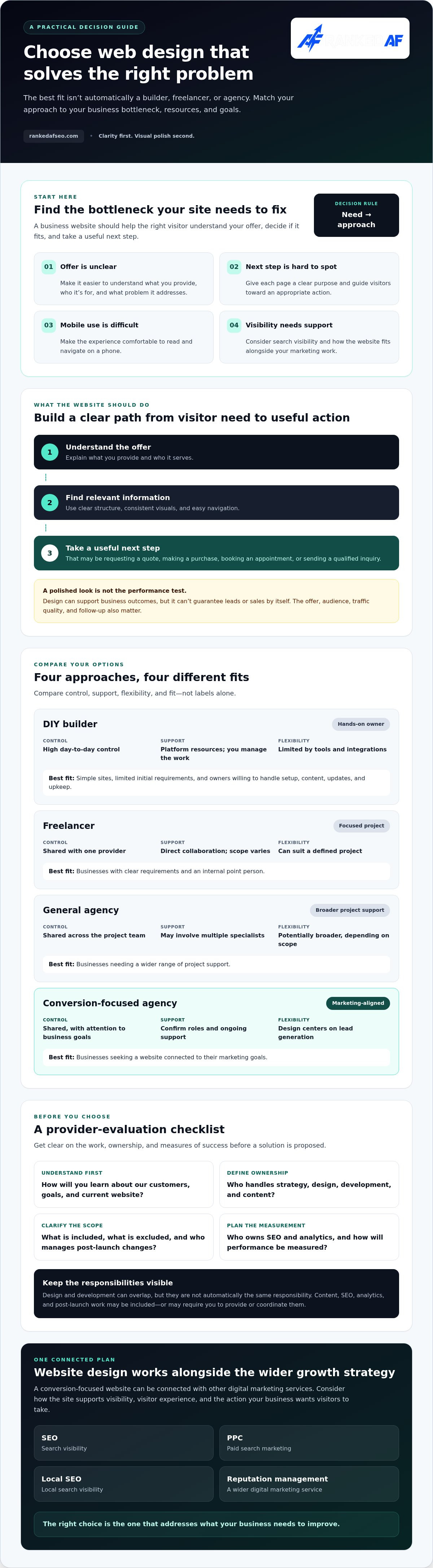
The right choice depends on the work your business needs done and what you can take on yourself. A simple site you can manage calls for a different setup than a website expected to support ongoing lead generation. Compare the options by control, support, flexibility, and fit, not by labels alone.
| Option | Control | Support | Flexibility | Best fit |
|---|---|---|---|---|
| DIY builder | High day-to-day control | Platform resources; you manage the work | Limited by available tools and integrations | Simple sites and hands-on owners |
| Freelancer | Shared with one provider | Direct collaboration; scope varies | Can suit a defined, focused project | Businesses with clear requirements and an internal point person |
| General agency | Shared across the project team | May involve multiple specialists | Potentially broader, depending on scope | Businesses needing a wider range of project support |
| Conversion-focused agency | Shared, with attention to business goals | Confirm roles and ongoing support | Design approach centers on lead generation | Businesses seeking a site connected to their marketing goals |
When is a DIY website builder the right fit?
A builder can work well for a straightforward site, limited initial requirements, and an owner willing to do the setup. You keep hands-on control, but you’re also responsible for content, updates, and upkeep. Before choosing, check that the platform supports the features and integrations your business needs. Digital.gov’s guidance on website usability can also help you assess whether a site works for its intended users.
When should a business consider a freelancer or agency?
A freelancer can offer direct collaboration for a clearly defined project. An agency may bring a broader team, but the actual mix of expertise depends on the provider and agreement. Ask who handles strategy, design, development, content, and post-launch changes. Don’t assume those responsibilities are included.
If the site needs to support lead generation as part of a wider marketing effort, a conversion-focused agency may be a strong fit. Ranked AF Media Group offers conversion-focused web design alongside SEO, PPC, local SEO, and reputation management. Review Ranked AF’s marketing services as one option, and compare the proposed strategy, responsibilities, and measurement plan with your business needs.
Investment varies with scope, complexity, and the support required. Get those details in writing before comparing proposals. A lower-touch option may suit a smaller requirement; a broader project may call for more hands-on expertise. Choose the level of support your goals actually demand.
Does Better-Looking Web Design Generate More Leads? Evaluate What Really Matters
A polished site can build confidence, but good looks alone don’t generate leads. Visitors also need to recognize that your offer fits their needs, understand what to do next, and reach a page that delivers on the promise that brought them there. The comprehensive guide to web design explores principles that connect design decisions with the user experience. For your business, judge those decisions by whether they help the right audience move forward.
Traffic quality matters, too. A page may attract visitors who aren’t a fit, or a strong inquiry may go nowhere if follow-up is slow or unclear. Set your primary business goal before a redesign, then choose signals that help you assess progress toward it. Treat clicks and page engagement as leading indicators, not proof of revenue or business impact.
| Design element | Visitor need | Useful signal |
|---|---|---|
| Clear offer and page content | Understand whether the business can help | Engaged visits to relevant service pages |
| Visible next step | Know how to make an inquiry or purchase | Call-to-action clicks and form starts |
| Usable form | Submit details without unnecessary friction | Form completion and valid submissions |
| Audience-aligned landing page | Find information that matches the ad or search | Qualified inquiries from that page or source |
Which website signals help show whether the experience is working?
Pick measures that match the site’s job. A lead-generation site should track qualified inquiries and form completion, while an online store would focus on purchase behavior. Engaged visits can help diagnose whether visitors use key pages, but they aren’t the outcome itself. Consider Google Analytics 4 or Google Search Console only after checking whether their reporting fits your measurement needs. Define what counts as a qualified inquiry before launch, then compare consistent measures over time.
How do usability, accessibility, and mobile experience affect decisions?
Visitors can’t act on an offer they can’t find, read, or use. Test the site on phones as well as larger screens. Check that navigation is understandable, text is readable, buttons are easy to select, and forms are practical to complete. Review accessibility using WCAG as a reference, and verify which requirements apply to your organization. A better experience can remove friction, but it can’t replace a relevant offer or effective follow-up.
How to Choose a Web Design Provider: A Practical Evaluation Checklist
Don’t choose on a polished pitch alone. A strong provider should understand what your business needs the site to do, explain what’s included, and show how progress will be assessed. Use this checklist to compare proposals on substance, not swagger.
- Define the goal. Decide whether the site should generate qualified inquiries, support sales, or help visitors take another specific action.
- Document requirements. List key pages, features, integrations, content needs, and any existing site issues the project should address.
- Compare the process. Ask how the provider learns about your customers, business goals, and current site performance. Look for a clear approach to turning those insights into project decisions.
- Verify the scope. Confirm deliverables, revisions, integrations, responsibilities, and post-launch support in writing. Clarify who owns the content and design files, who controls website access, and who handles ongoing maintenance.
- Set measurement. Agree on the metrics that match your goal, how they’ll be tracked, and when performance will be reviewed. Make sure the analytics setup can support the plan.
What questions should you ask before signing a web design agreement?
Ask what the proposal includes and what falls outside it. Who creates or supplies the content? How many review points are planned, and who approves decisions? What happens if requirements change? Clarify which integrations are included and what post-launch help covers. A useful agreement names project roles, milestones, client responsibilities, and the process for requested changes. If an answer is vague, get it clarified before signing.
How can you assess a provider’s results without falling for big promises?
Ask for relevant examples and the context behind any performance claim: the starting point, timeframe, work involved, and how results were measured. A clear process and credible evidence can help you evaluate a provider. Neither guarantees that your business will get the same outcome. Be cautious of promises about future traffic, revenue, or lead volume. Check that proposed metrics match your goals and that your analytics can track them reliably.
Look for specifics, not certainty. A provider should be able to explain how they’ll make decisions and assess the work without pretending they control every factor that affects business results. If you’re comparing approaches, see how Ranked AF approaches conversion-focused web design.
Ranked AF Web Design: Connect Your Website to a Wider Growth Strategy
A website doesn’t work in isolation. The message on a landing page needs to make sense alongside the search result, ad, or local listing that brought someone there. Ranked AF Media Group offers conversion-focused web design intended to support lead generation, alongside services including SEO, Google Ads (PPC) management, local SEO and Google Maps optimization, and reputation management.
That wider mix may be relevant if your business wants its website and digital marketing activity considered together. For example, a visitor arriving from a paid ad should find a page that reflects the ad’s message and makes the next step clear. Someone discovering a business through local search may need information that supports a confident inquiry. Aligning these pieces can create a more coherent experience, but it doesn’t guarantee a particular number of leads, rankings, or sales.
When does integrated web design make sense for a business?
Consider an integrated approach if your website is central to how you attract and convert customers, and separate marketing efforts feel disconnected. The useful question isn’t simply whether design and marketing sit under one roof. Ask how the proposed work will connect your audience, page messaging, traffic sources, and conversion goal. A clear strategy should explain those links without promising results no provider can guarantee.
Ranked AF’s services include SEO, PPC, local SEO, and reputation management. How these services relate to a website project depends on your goals and the agreed scope. Before choosing a provider, check whether the approach addresses your actual bottleneck, such as unclear messaging, a mismatch between an ad and its landing page, or a weak path from discovery to inquiry.
What should the next step look like?
Start with the problem, not a list of design features. Before requesting a discussion, write down what you want the website to do, who needs to use it, and what currently gets in the way. Bring any known performance concerns, such as pages that attract visits but seem to generate few inquiries. That context helps you assess whether a proposed strategy fits and what needs to be measured.
Confirm project-specific details before committing. Ask which platform the project would use, what deliverables and responsibilities are included, what the timeline depends on, and how measurement will be handled. Those answers should reflect your requirements, not assumptions. If you’re looking for a website approach connected to broader marketing goals, talk with Ranked AF about a website built to support your goals.
Choose a Website That Moves Your Business Forward
The right web design approach starts with your business bottleneck, not the platform or the flashiest mockup. Choose a DIY builder, freelancer, or agency based on your goals, resources, and the support you need. Then get clear on scope, ownership, and how you’ll measure progress before work begins.
Visual polish matters, but it can’t carry the whole job. Your offer, audience, page experience, traffic quality, and follow-up all shape whether a visitor takes action. A website should support your business goals, not promise outcomes it can’t control.
Ranked AF Media Group offers conversion-focused web design intended to support lead generation, alongside SEO, PPC, local SEO, and reputation management. If you want to explore an approach that connects your website with broader marketing goals, talk with Ranked AF about conversion-focused web design.
Make the next decision with a clear goal and the right questions. Your website can become a stronger part of how your business earns attention and turns interest into action.
Frequently Asked Questions
What is web design?
Web design is the planning of a website’s visual presentation, structure, and user experience. It shapes how visitors find information and move through pages. Website development implements the functionality that makes the site work. Projects may also coordinate design with content, SEO, and analytics, but those responsibilities depend on the provider and agreed scope. Strong design starts with your audience’s needs and business goals, not simply picking colors or a template.
How much does web design cost?
There’s no reliable single price without defining the project. The investment can depend on the number of pages, content needs, integrations, custom functionality, and ongoing support. Compare written scopes rather than headline quotes, and check that proposals cover the same requirements. Ask what’s included, what costs extra, and who handles post-launch work. For a specific project, confirm current scope and pricing directly with the provider rather than assuming a standard fee.
Is a website builder good enough for a small business?
A website builder can suit a small business with straightforward needs, time to manage the site, and comfort handling setup and updates. It may be less suitable if you need specialized functionality, deeper strategy, or coordinated marketing support. Start by listing essential features and responsibilities, such as who will create content and maintain pages. Then compare those needs with the platform’s current capabilities, integrations, and support options before committing.
Can web design improve SEO?
Web design can support SEO when it creates clear site structure, usable pages, mobile-friendly experiences, and content search engines can access. It doesn’t guarantee rankings. Search performance also depends on factors such as content relevance, technical setup, and competition. Align your site architecture and page content with what people are searching for, then use tools such as Google Search Console to monitor visibility and identify issues that may need attention.
How do I choose a web design company?
Choose a provider by comparing its approach with your business goals and audience needs. Ask how it learns about your customers and existing site performance, then confirm scope, project roles, decision points, and post-launch support. Clarify who handles design, development, content, and integrations. Request relevant examples and review any performance claims in context. Past results can show experience, but they don’t promise the same outcome for your business.
What makes a website convert visitors into leads?
A website is more likely to generate leads when the page matches visitor intent and makes the next step clear. Use specific messaging, a relevant offer, trust-building information, and a form that’s straightforward to complete. Traffic quality matters: the right visitors are more likely to be potential customers. Follow-up matters, too. Define the action you want visitors to take and track qualified inquiries, rather than judging performance by appearance or raw traffic alone.
Should web design include SEO and ongoing optimization?
SEO and ongoing optimization can be coordinated with web design, but what’s included depends on the provider and agreement. Ask whether technical setup, search-focused content, analytics, and post-launch improvements are part of the proposed scope or separate work. If your business relies on organic traffic, clarify who owns each task, who provides the information needed, and how often performance will be reviewed. Clear responsibilities help prevent important work from falling through the cracks.


