

The loudest SEO pitch is often the one worth questioning. If you’re comparing seo companies for small business, a polished promise of first-page rankings can sound reassuring, especially when you have little time to vet providers. But rankings alone don’t show whether the work will bring qualified calls, inquiries, or sales.
It’s reasonable to ask what you’re paying for, how progress will be measured, and who controls your website and analytics accounts. Effective SEO connects practical work, such as improving search visibility and helping prospective customers take action, to goals that matter to your business. No agency can honestly guarantee a specific Google ranking.
This guide explains how to match SEO services to your needs, compare providers using clear criteria, spot vague methods and vanity reporting, and ask sharper questions before you sign or share account access. You’ll learn what a credible plan should explain, what proof to request, and which promises deserve a hard pass. Choose the partner who makes the work and accountability clear, not the one with the flashiest pitch.
Key Takeaways
- Start with the business outcome you need, then prioritize SEO work that supports it instead of buying a broad package by default.
- Compare seo companies for small business by their strategy, specific deliverables, measurement, communication, contract terms, and fit.
- Ask providers to explain what they’ll do, why it matters, and how they’ll assess progress in plain language.
- Treat guaranteed rankings, unclear methods, vague scopes, and pressure to sign as reasons to pause and ask sharper questions.
- Define your goals, verify claims, and agree on how progress will be measured. Set initial priorities after discovery and a review of your website.
What Small Business SEO Companies Do and Don't Do
An SEO company works to improve how easily people can find your business through unpaid search results. That usually involves researching what customers search for, making agreed changes to your website or online presence, and measuring what happens. A neutral Search Engine Optimization (SEO) overview can help clarify the basics. The work may include technical SEO, on-page improvements, content recommendations, or local search visibility. There is no single switch that fixes everything.
Keep service boundaries clear. Organic SEO aims to improve visibility in unpaid search results. Paid advertising buys ad placements, web design changes how a website looks or functions, and social media management handles activity on social platforms. These services can support one another, but they aren’t interchangeable. Some providers offer several of them. Ask what the proposal includes instead of assuming the label “SEO” covers everything.
The right scope depends on your goals, your website’s condition, the competition for the searches you care about, and how customers make decisions. A local business may need map visibility and clear service information. An online store may need better product discovery. A site with technical problems may need those addressed before a larger content effort makes sense. Good seo companies for small business should connect proposed work to your situation, not apply the same checklist to every client.
Which SEO tasks can a small business hire out?
Ask whether the proposal includes a website audit, keyword and search-intent research, technical recommendations or fixes, and guidance for improving existing pages or creating useful content. Local businesses may also need Google Business Profile and Google Maps optimization. The proposal should name the deliverables, identify who is responsible for them, and explain how progress will be reviewed. “Ongoing optimization” on its own tells you little.
What SEO cannot responsibly promise
No agency controls search engine algorithms, so no provider can responsibly guarantee a specific ranking. An agency can describe the work it plans to complete and track indicators such as search visibility, relevant website visits, or inquiries. Those indicators aren’t guarantees of leads, revenue, or results by a promised date. Ask how the provider will assess progress and what factors could affect it.
SEO is ongoing work to improve search visibility, and its outcomes depend on your website, your market, customer behavior, and search engine changes. That’s the honest version. If a pitch replaces clear tasks and measurement with certainty about rankings or sales, ask for specifics before you commit.
Match SEO Services to Your Small Business Goals Before Comparing Agencies
Before comparing proposals, name the business result you need. Do you want more qualified inquiries, better product discovery, stronger local visibility, or more visitors taking the next step? The answer helps determine which work is worth paying for. Without it, you can end up with a long list of SEO tasks that has no clear connection to your business.
Start with the website you have, not the content calendar an agency wants to sell. If key pages are hard to use or technical issues get in the way, adding more content may not solve the underlying problem. Ask providers to review your site and explain what should come first, what can wait, and why. The right scope depends on your stage, your competition, and how customers search and choose.
Choose an SEO scope that fits your stage
A newer or smaller website may need technical cleanup and focused service pages that clearly explain what you offer. An established site may have different priorities, such as filling content gaps, strengthening internal links between relevant pages, or attracting more qualified search traffic. If customers look for services in a defined area, ask whether local search and Google Business Profile optimization belong in the plan. For seo companies for small business, a tailored priority list is more useful than a generic package.
Separate immediate demand from long-term visibility, too. Paid ads can put your offer in front of searchers through advertising, while organic SEO works to improve visibility in unpaid results over time. If you need traffic quickly, ask how Google Ads management fits into your broader plan rather than expecting SEO to deliver instant results. If customers are finding information through AI-powered answers as well as traditional search, explore whether AI search optimization services match your goals.
Connect visibility to the website experience
Search traffic has value when visitors land on a page that answers their questions and makes the next step obvious. Review key pages on mobile. Is the offer clear? Can visitors find relevant details and a contact or purchase path without hunting? Ask the agency to consider page clarity, mobile usability, and lead paths alongside its SEO recommendations. More visibility won’t fix a confusing experience.
If the website itself needs work, compare SEO priorities with conversion-focused web design options. A provider offering both may be worth assessing, but make sure each part of the proposed scope is clearly defined. Ranked AF Media Group offers SEO, local SEO and Google Maps optimization, AI Search Optimization, and conversion-focused web design. You can review its digital marketing services as one option while deciding what fits your business.
How to Compare SEO Companies for Small Business Without Guesswork
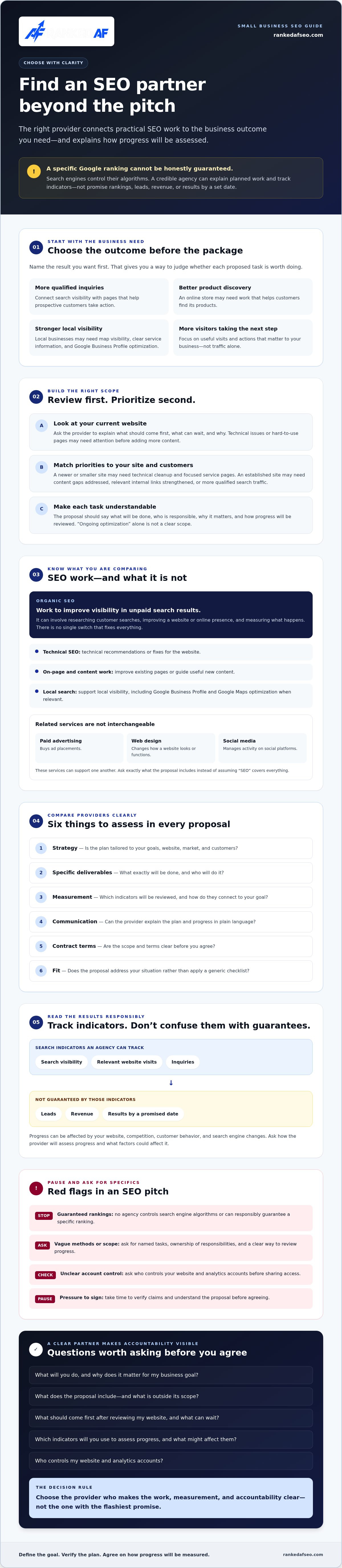
Don’t choose based on the slickest deck or the longest service list. Put every proposal through the same scorecard. For seo companies for small business, a fair comparison starts with what each provider plans to do, how the work fits your goals, and how you’ll know whether it’s useful.
A transparent scope and relevant measurement are stronger signs of a trustworthy SEO partner than bold claims. Ask each company to explain what it will do, why it matters to your business, and how progress will be assessed. If the answer stays vague, the proposal isn’t ready for a yes.
Use this scorecard:
- Strategy: Does it reflect your business goals and current website, or could it be sent to any company?
- Deliverables: Are specific tasks and outputs named, with responsibilities clearly assigned?
- Measurement: Does reporting connect search data to useful business context, or stop at rankings and traffic totals?
- Communication: Do you know who explains progress, how often you’ll hear from them, and how questions are handled?
- Contract terms: Are scope, approval requirements, cancellation terms, and changes explained clearly?
- Business fit: Does the provider understand your customers, priorities, and capacity to act on recommendations?
What should a credible SEO proposal include?
Look for a diagnosis of your current site, followed by priorities tied to the goals you shared. A credible proposal identifies deliverables, who handles each task, the communication cadence, and how progress will be measured. Ask what’s included, what requires your approval, and how changes to the scope are agreed. Don’t settle for “we’ll optimize your site” without a clear explanation of the work behind it.
How to judge reporting and communication
Request a sample report or ask the provider to explain how it shares completed work, recommendations, and next steps. Useful reporting explains what changed, what the data may indicate, and what action follows. Rankings, traffic totals, and activity counts can provide context, but they don’t tell the whole story. Ask how the provider will connect search performance to your business goals. This webmaster tools and search data guidance can help you understand the information behind SEO reporting.
Compare proposals side by side, then follow up on every unclear point. The right partner won’t hide behind jargon or treat questions like a nuisance. You should understand the plan before agreeing to it.
SEO Agency Red Flags: Spot Guarantees, Foggy Deliverables, and Risky Access
Some warning signs appear before a campaign begins. Treat guaranteed rankings, “proprietary” methods no one can explain, or pressure to sign before the scope is clear as reasons to pause. A provider should be able to describe its approach in plain language. If deliverables are vague, reports arrive without explanation, or the agency won’t discuss how it measures progress, ask direct questions before moving forward.
Don’t rely on a wall of client logos, either. Ask for references or relevant case studies, then verify the claims directly. Find out what work was done, what the business was trying to achieve, and how results were measured. A logo proves little on its own.
Questions to ask before signing an SEO agreement
Clarify how the working relationship will operate. Ask who performs the work, who communicates progress, and how recommendations are approved. Confirm the contract length, cancellation terms, account and content ownership, and what work may be billed beyond the agreed scope. Then ask what the agency considers a useful early indicator and which outcomes depend on factors it can’t control. The answers should be specific enough to put in writing.
- What tasks will you complete, and who is responsible for each?
- How often will you share progress and explain next steps?
- What requires my approval, and how are scope changes handled?
- What early signals will you track, and what could affect results?
A longer agreement isn’t automatically a scam, and a particular tactic isn’t automatically unsafe in every situation. The test is whether the terms, rationale, responsibilities, and exit process are clear and acceptable to you. Don’t sign until they are.
Protect your website and marketing accounts
Your business should retain ownership of its key website, analytics, search, and business-profile accounts. Give a provider only the access needed for the agreed work, and avoid handing over shared passwords when account-level permissions are available. Before work starts, confirm how credentials, tracking data, content, and completed work will be handled if the relationship ends. Make sure you can still access the accounts and materials you own.
These safeguards matter with any provider, including seo companies for small business. A trustworthy partner should be comfortable discussing access and ownership rather than using them as leverage. Ask for unclear terms in writing, keep copies of agreements and completed work, and verify claims before you commit.
If clear scope and account access are priorities, review Ranked AF Media Group’s SEO services and assess whether the stated work fits your needs.
Choose an SEO Partner and Set a Clear First 90-Day Direction
You don’t need a perfect forecast before choosing a provider. You do need a clear way to move from the first conversation to accountable work. Use this sequence:
- Define the goal: Name the business outcome and the customers you want to reach.
- Shortlist providers: Look for relevant capabilities and a willingness to understand your business before prescribing tactics.
- Compare proposals: Check scope, responsibilities, communication, and measurement side by side.
- Verify claims: Follow up on references, examples, and anything that sounds unclear.
- Agree on measurement: Decide what information will guide decisions and how you’ll review progress.
The first 90 days are a planning horizon, not a promise of rankings or revenue. Early priorities should follow discovery and a review of your current website, goals, and available data. A credible partner should identify what it still needs to learn, then explain how it will check those unknowns before setting a strategy.
What to prepare for an initial agency conversation
Bring your business priorities, a description of your target customers, and access to the website or relevant accounts if you’re ready to share them. Gather analytics or search performance data if available, but don’t treat missing or incomplete data as a reason to delay the conversation. Ask the provider to separate confirmed findings from assumptions and explain what it needs to verify before recommending specific work.
Turn the proposal into an accountable working plan
Before work begins, agree on priorities, responsibilities, what needs your approval, how communication will work, and which measures will inform decisions. If paid ads, reputation management, or website improvements are also relevant, ask how those efforts could coordinate with SEO and where each service’s scope begins and ends. The plan should make next steps understandable, not bury them in jargon.
Ranked AF Media Group offers SEO, Local SEO and Google Maps optimization, AI Search Optimization, and conversion-focused web design. Those capabilities may suit different needs, from improving organic visibility to addressing local discovery, AI-driven search, or website experience. Assess the proposed scope against your priorities instead of assuming every service belongs in the plan.
If you’re weighing your options, talk with Ranked AF Media Group about your goals and whether its services fit. Start with the business need, the evidence, and a plan you can understand.
Choose a Partner That Makes the Work Clear
The right SEO partner doesn’t sell certainty. They connect the work to your business goals, explain what they’ll deliver, and show how progress will be assessed. Before you choose among seo companies for small business, compare the scope, ask how your accounts and data will be handled, and make sure the plan reflects your website and customers.
Keep the focus on more than rankings. Search visibility matters when it helps the right people find your business and take a meaningful next step. The clearest proposals make priorities, responsibilities, and measurement understandable from the start.
Ranked AF Media Group offers SEO and AI Search Optimization, Local SEO and Google Maps optimization, and conversion-focused web design. If those services may fit your goals, talk through your SEO goals with Ranked AF Media Group and assess the scope before deciding. You need a partner who can explain the plan and work toward the outcomes that matter to your business.
Frequently Asked Questions
How do I choose an SEO company for a small business?
Start by defining the business outcome you need, then compare seo companies for small business on scope, communication, measurement, and contract clarity. Ask each provider to explain its recommendations in plain language and connect them to your website and customers. Verify references or case studies directly. Don’t choose solely on price, promised rankings, or a polished sales presentation. Look for a plan you understand and can assess.
Can an SEO company guarantee first-page rankings?
No, a responsible SEO company can’t guarantee a specific Google ranking because search results and algorithms are outside its control. A credible provider can explain its process, complete agreed work, and report on relevant indicators, but it shouldn’t present a ranking as certain. Before agreeing to a campaign, ask what work will be done, how progress will be evaluated, and which external factors could affect results.
How much does SEO for a small business cost?
There’s no single appropriate fee for every small business, and scope matters as much as the quoted amount. Work can vary based on your website’s condition, competition, service area, content needs, and goals. Ask for an itemized proposal that spells out deliverables, exclusions, contract terms, and additional charges. Then compare what each provider will do and how the work will be assessed, not just the headline price.
What services should a small-business SEO company provide?
The right service mix depends on your goals and may include a technical review, search-intent research, on-page recommendations, content planning, and local search optimization. Ask which tasks should come first and who will complete them. A provider should also explain how it will assess progress and whether website conversion issues need attention. Be cautious of a long task list that isn’t tied to your business priorities.
How long does SEO take to work for a small business?
SEO has no guaranteed timetable. The time it takes to see meaningful movement can depend on your website’s starting point, competition, how quickly recommended changes are implemented, and search demand. Ask the agency to distinguish early completed work from longer-term outcomes and explain what it will review along the way. A trustworthy plan sets realistic expectations without promising a specific result by a fixed date.
Is hiring an SEO company worth it for a small business?
It can be worthwhile if you have clear goals, need expertise or time you don’t have in-house, and find a provider with a transparent plan. It may not be your first priority if essential website information or business operations aren’t ready. Compare the proposed work with what your team can handle, then ask how recommendations could support qualified traffic, inquiries, or another outcome that matters to your business.
What are the warning signs of a bad SEO company?
Watch for guaranteed rankings, unclear deliverables, pressure to sign immediately, unexplained reports, and reluctance to discuss account ownership or contract terms. Any one sign calls for questions, not an instant verdict. Ask for specifics and verify claims. Before granting access, confirm that your business retains appropriate ownership of its website, analytics, and business profiles, and that you understand how to review the work and what happens if the relationship ends.


